Colony Flow Level 1360 Walkthrough & Step-by-Step Guide
Advanced
Editorial Team
Level 1360 video solution · published October 6, 2026
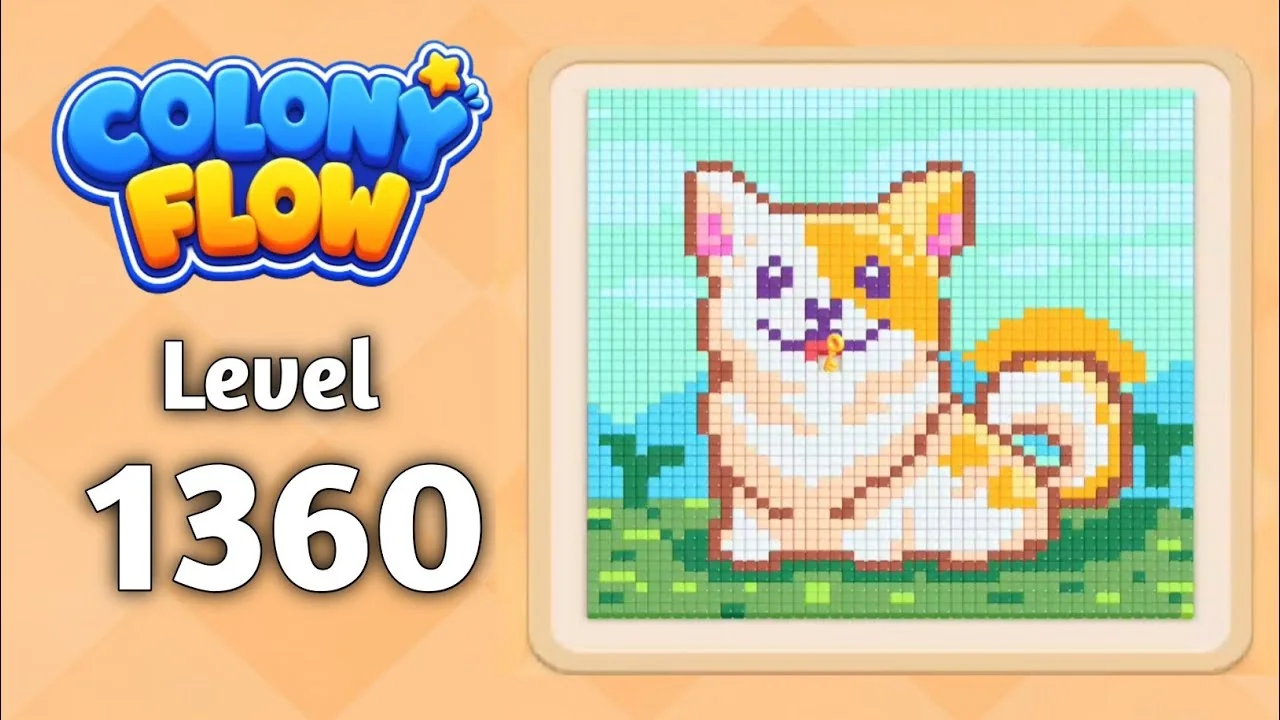
Watch on YouTube →Colony Flow Level 1360 is a pixel-art board. Measured from the board image on this page, the picture breaks down into 9 colours, each covering at least 2% of the board: pale cyan covering the most at 18.8%, then white (11.5%) and faint cyan (10.8%), with 6 smaller colours behind them. The cream that frames the picture reads as the board's empty background - it frames the artwork rather than forming part of it.
Level board
Illustrated walkthrough
Editorial Team
How do you beat level 1360? Watch the video or follow the step-by-step picture and text guide to complete it!
Level 1360 is an Advanced five-seat clear of a cream-and-orange pixel puppy resting on a turquoise and green field. You tap coloured blocks from the bottom tray into the seats; matching ants leave the centre hole and eat every pixel of that colour. The artwork is built from Green and Light green grass, a Pale teal and Cyan turquoise field, a White belly and face, Peach body highlights, Brown paws and outline, warm Yellow details, Red collar pixels, Purple eyes, and Pink late body accents. This board has no wooden chest - the linked cells across the tray are the real pacing gates.
The measured clear finishes at 6:27 (empty board, fill 0.007). The Colony Flow logo arrives at 6:28 and the Victory overlay at 6:31, and neither belongs in the tap timeline. The opening fills only four seats, pale blocks are genuine seats rather than empty slots, and the linked cells are one path each, not free taps.
Level 1360 at a glance
| Detail | Level 1360 |
|---|---|
| Difficulty | Advanced |
| Seats | 5 |
| Measured seat colours | Green, Light green, Pale teal, Cyan, Pale cyan, Brown, Yellow, Peach, White, Red, Purple, Pink |
| Special gate | None - no wooden chest on this board |
| Tray quirks | Linked cells across the tray (including a blue-cyan pair and linked Green cells); dimmed back-row cells are not tappable |
| Clear time | ~6:27 |
| Source run | The video solution above |
The ten-step route
| # | Time | What happens | Where it happens |
|---|---|---|---|
| 1 | 0:05-0:20 | Green, Light green, Pale teal and Brown take the first four seats | Lower-left grass + tail |
| 2 | 0:20-0:50 | Seat 4 cycles between Brown and Red while the other seats drain | Grass band + tail edge |
| 3 | 0:50-1:15 | Five-seat refresh: Light green, Pale teal, Brown, Cyan, Yellow | Lower grass + linked tray cells |
| 4 | 1:15-2:00 | Peach, White and Cyan replacements join Light green and Pale teal | Tail spiral + pale body edge |
| 5 | 2:00-3:00 | Green, Brown and Peach carry the first large body clear | Centre body, grass + tail |
| 6 | 3:00-3:45 | White, Pale teal, Green and Peach thin the white body | Belly, lower face + grass |
| 7 | 3:45-4:12 | Yellow, Green, White, Red and Cyan open the upper field | Ears + upper turquoise field |
| 8 | 4:12-4:40 | Purple and Pale teal first, then Pink and White | Eyes, muzzle + upper sky |
| 9 | 4:40-5:45 | Pink, Pale teal, White, Pale cyan, Brown, then Peach and Yellow | Orange head + lower body + tail |
| 10 | 5:45-6:27 | Final Pink, Peach, Yellow and Brown, then Pale teal and Cyan | Last outline + whole board |
Mnemonic: Green·Light green·Pale teal·Brown -> Brown·Red -> Light green·Pale teal·Brown·Cyan·Yellow -> Light green·Pale teal·Peach·White -> Green·Brown·Peach -> White·Pale teal·Green -> Yellow·Green·White·Red·Cyan -> Purple·Pale teal·Pink·White -> Pink·Pale teal·Brown·Peach·Yellow -> Pink·Peach·Brown·Pale teal -> clear at 6:27.
Step 1 - Four seats fill at the opening (0:05-0:20)
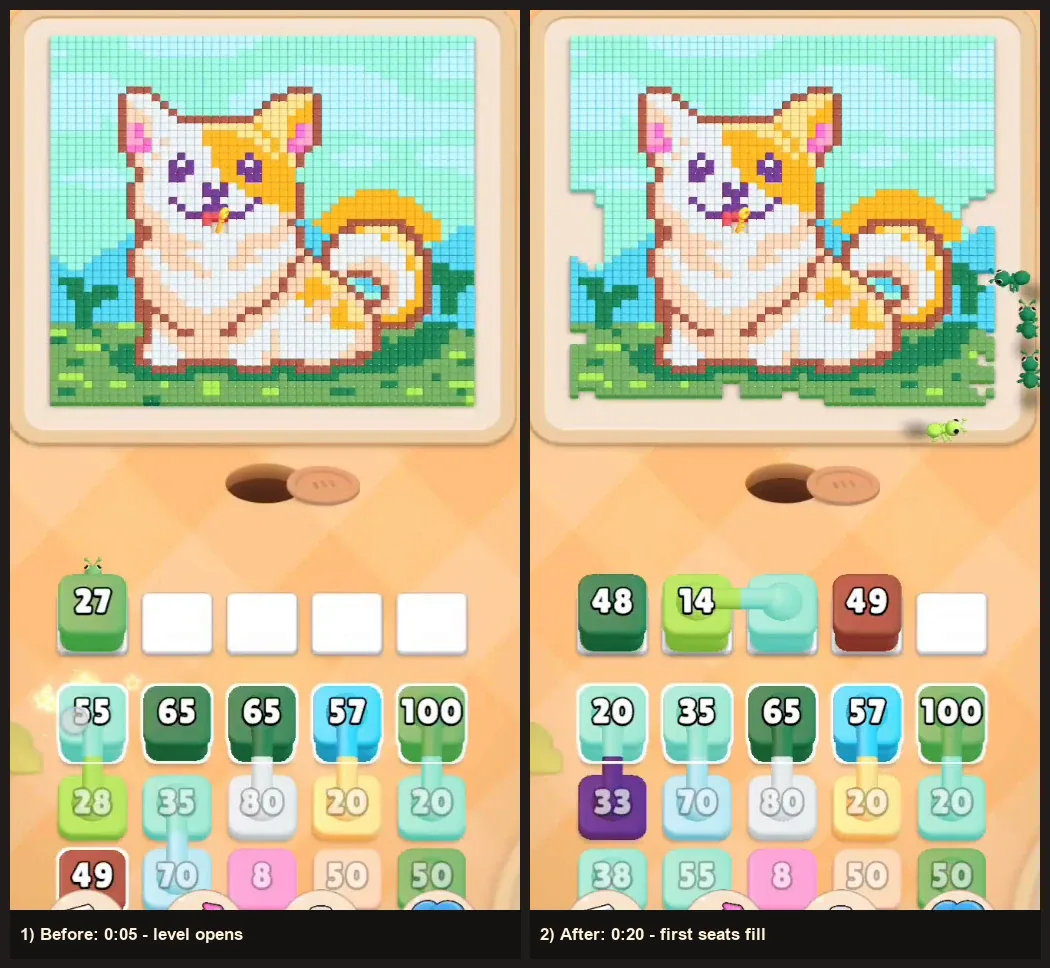
At 0:05 only one front-row tray block is lit. By 0:07 the row holds Green, Light green, Pale teal and Brown in seats 1-4, and seat 5 is still blank. The ants start on the lower-left grass and the tail, and fill only moves from about 0.80 downward.
- What to do: seat the four available colours at once and start draining the grass with the green family.
- Why it works: the opening has a single unlocked cell, so four seats fill from the first lit chain rather than from a five-block wave.
- Do not: wait for a fifth seat - seat 5 is genuinely empty here, not a pale block.
Step 2 - Brown and Red trade the fourth seat (0:20-0:50)
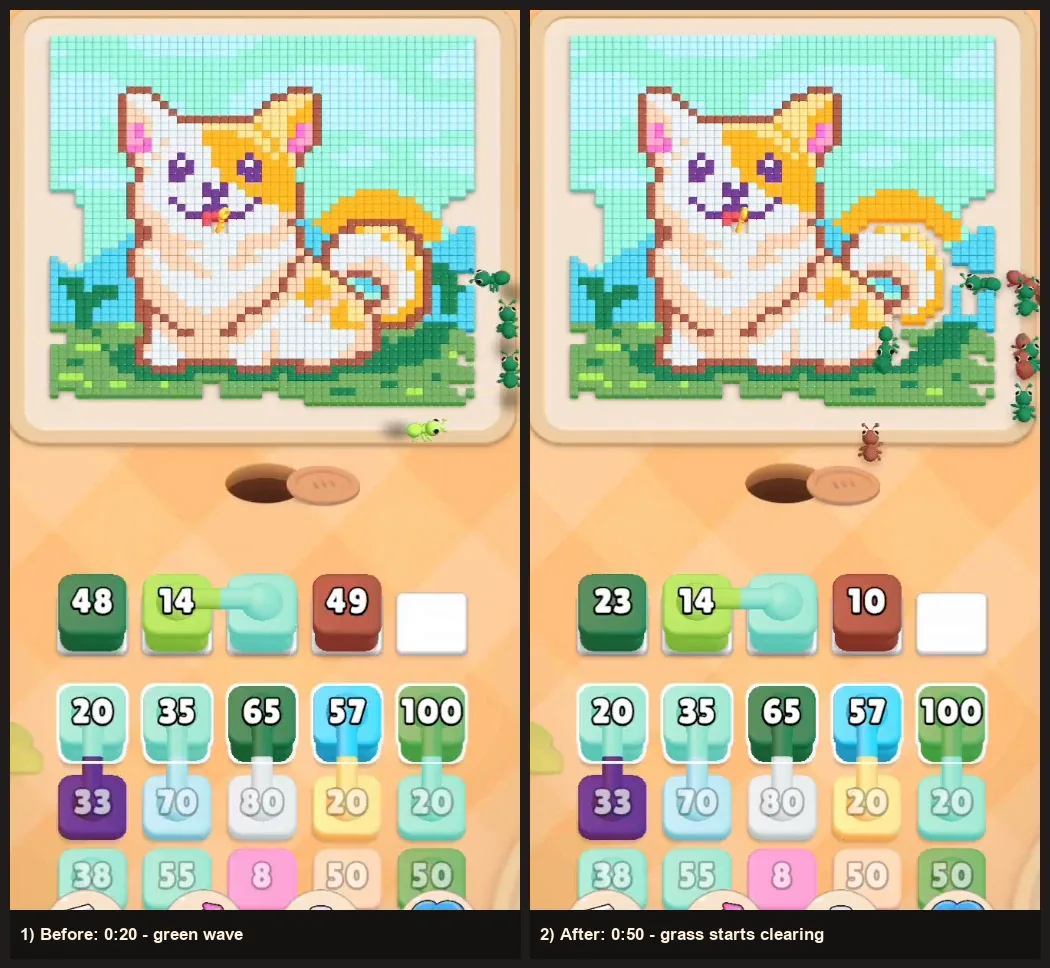
Through 0:20-0:50 seats 1-3 keep ticking down while seat 4 repeatedly changes between Brown and Red. These are replacements inside one seat, not new seats opening. The lower-left grass loses its first large patches, the tail edge thins, and fill stays near 0.77.
- What to do: read seat 4 by the block colour and its printed count, not by the ant trail around it.
- Why it works: Brown and Red are both small board groups here, so either one keeps the ants fed on the pot and collar pixels.
- Do not: log a new step for every Brown-to-Red swap - it is the same seat being refed.
Step 3 - A five-seat refresh at 1:07 (0:50-1:15)
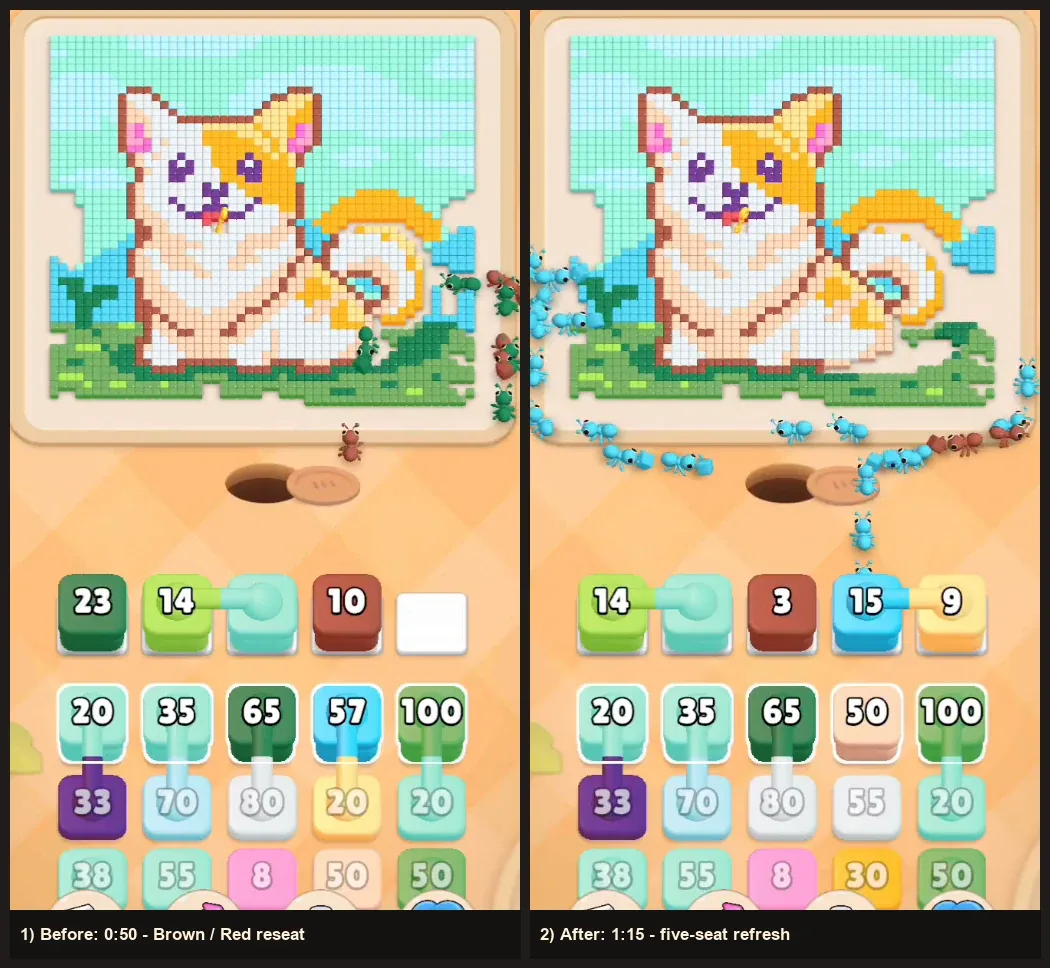
At about 1:07 all five seats refresh together with Light green, Pale teal, Brown, Cyan and Yellow. Several of those cells are chained to a neighbour by a tray tube. The lower grass and the tail edges lose more pixels and fill falls from about 0.77 to 0.73.
- What to do: take the lit end of each linked pair first.
- Why it works: five colours at once split the lower grass, the pale body edge and the tail into separate regions.
- Do not: tap a dimmed tubed cell just because its colour matches the board.
Step 4 - Pale wave on the tail and edges (1:15-2:00)
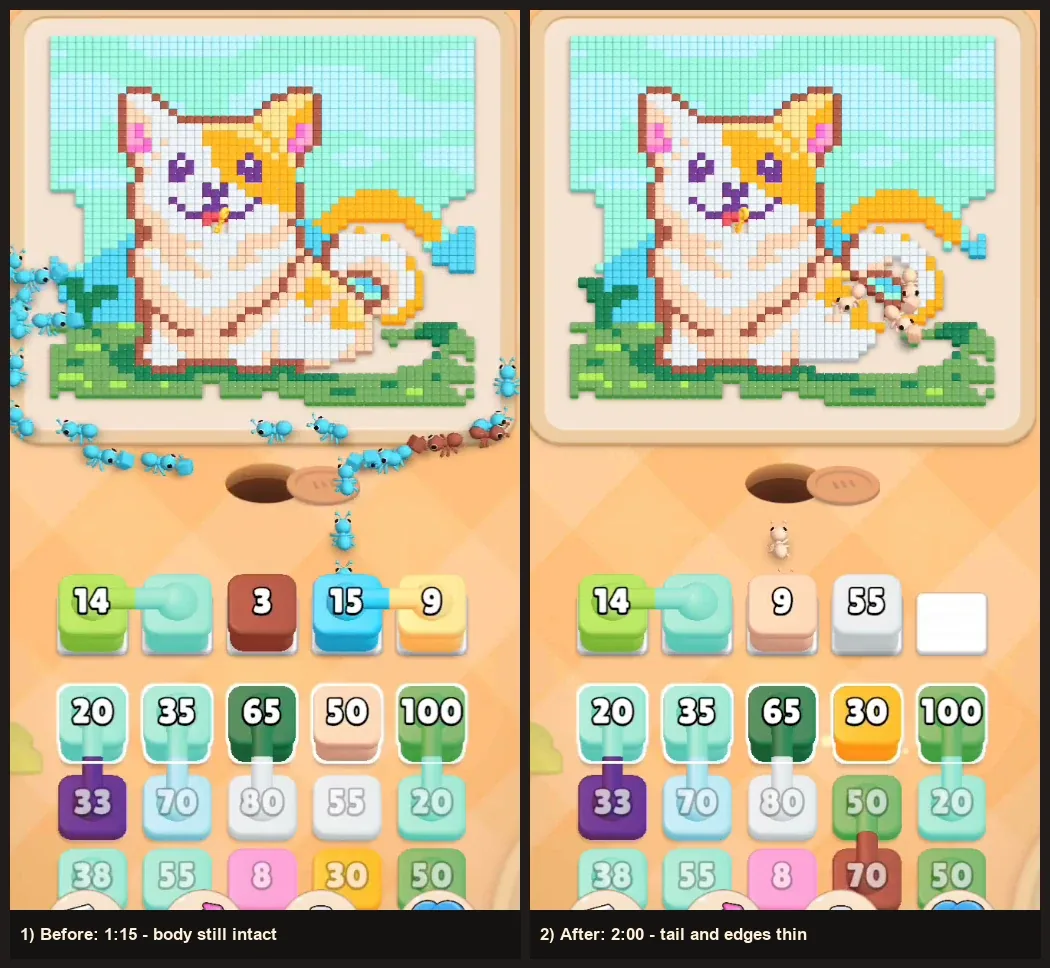
Light green and Pale teal stay in the row while the middle seats take Peach, White and Cyan replacements. The tail spiral and the pale edge of the body begin to open and fill is still high at about 0.72.
- What to do: confirm a pale seat by its printed count and its outline before treating it as occupied.
- Why it works: White, Pale teal and Cyan all live on the pale body edge and the turquoise field, so this wave is the first real opening.
- Do not: call the pale blocks empty seats - at this size they look like blank slots.
Step 5 - First large body drop (2:00-3:00)
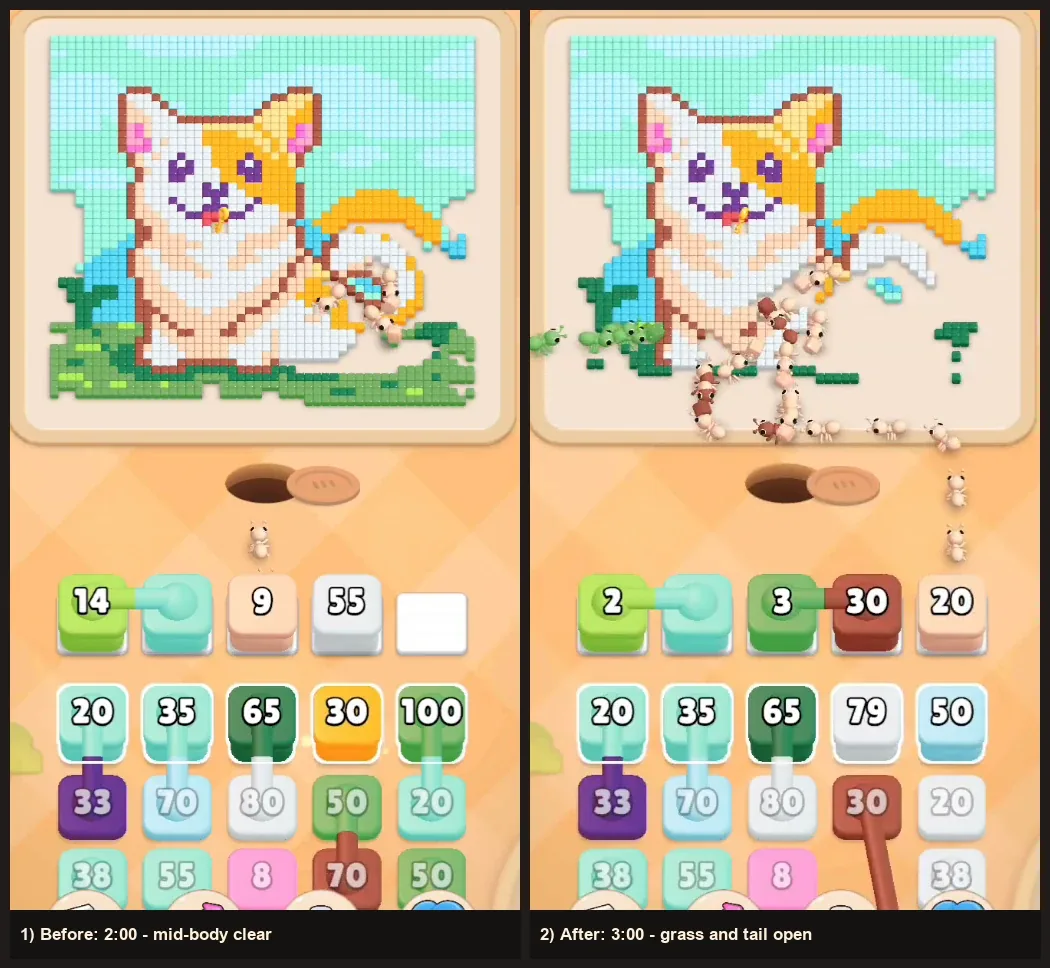
The next sustained wave uses Green, Brown and Peach while pale green and pale teal stay in the front seats. The central white body, the lower grass and part of the tail open into cream, and fill falls from about 0.72 to 0.61.
- What to do: keep all five seats busy during this transition.
- Why it works: the large open areas are eaten by the matching pale colours, not by tapping the cream background.
- Do not: confuse the cream that appears with a new colour family - cream is the empty background.
Step 6 - The white body thins (3:00-3:45)
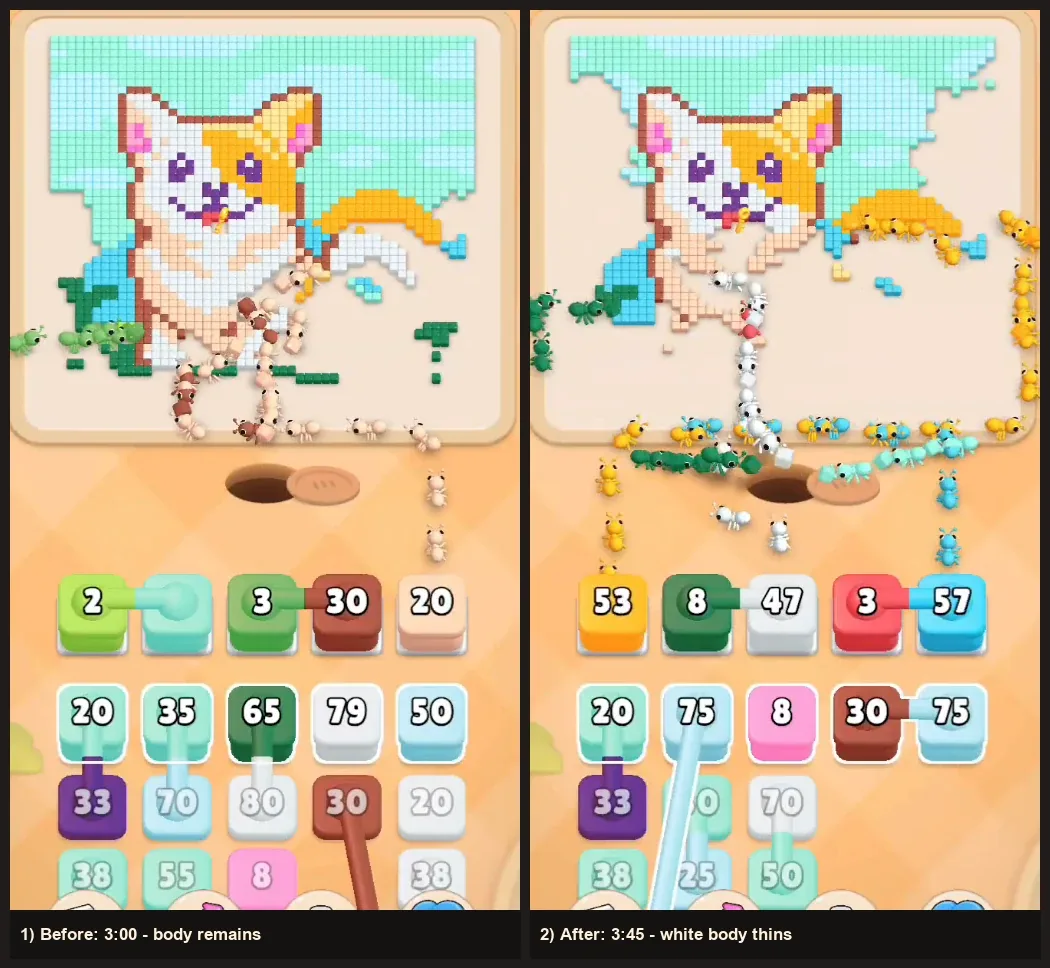
White, Pale teal, Green and Peach continue through the seat row, and around 3:41-3:45 the row refreshes toward yellow, green, white, red and cyan. The white belly, the lower face and the remaining grass lose their dense blocks, and fill drops from about 0.61 to 0.44.
- What to do: let the long White drain finish the belly before replacing it.
- Why it works: the belly is the largest single white mass on the board, so one White seat can drain it for a long time.
- Do not: read a long White drain as five empty seats - the block is still active while its count ticks.
Step 7 - Upper field and ears (3:45-4:12)
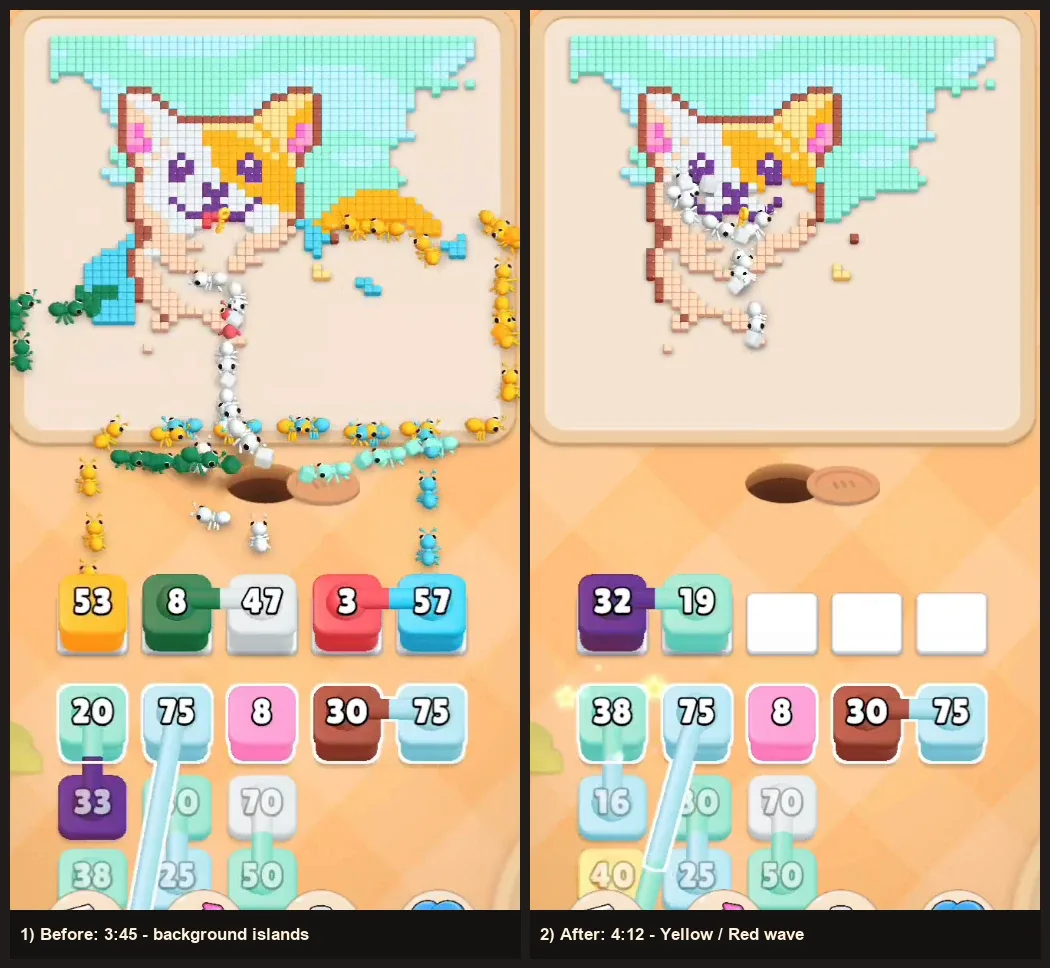
A fresh five-colour wave seats Yellow, Green, White, Red and Cyan. The linked blue-cyan cells stay useful for the upper background. The turquoise field around the ears and the white face details break into islands, and fill falls from about 0.44 to 0.37.
- What to do: seat every colour in this burst when a slot is open.
- Why it works: the turquoise field is the biggest remaining region, and only Cyan and Pale teal can eat it.
- Do not: park Yellow or Cyan behind four White blocks - it leaves the ears and sky behind.
Step 8 - Eyes, muzzle and sky detail (4:12-4:40)
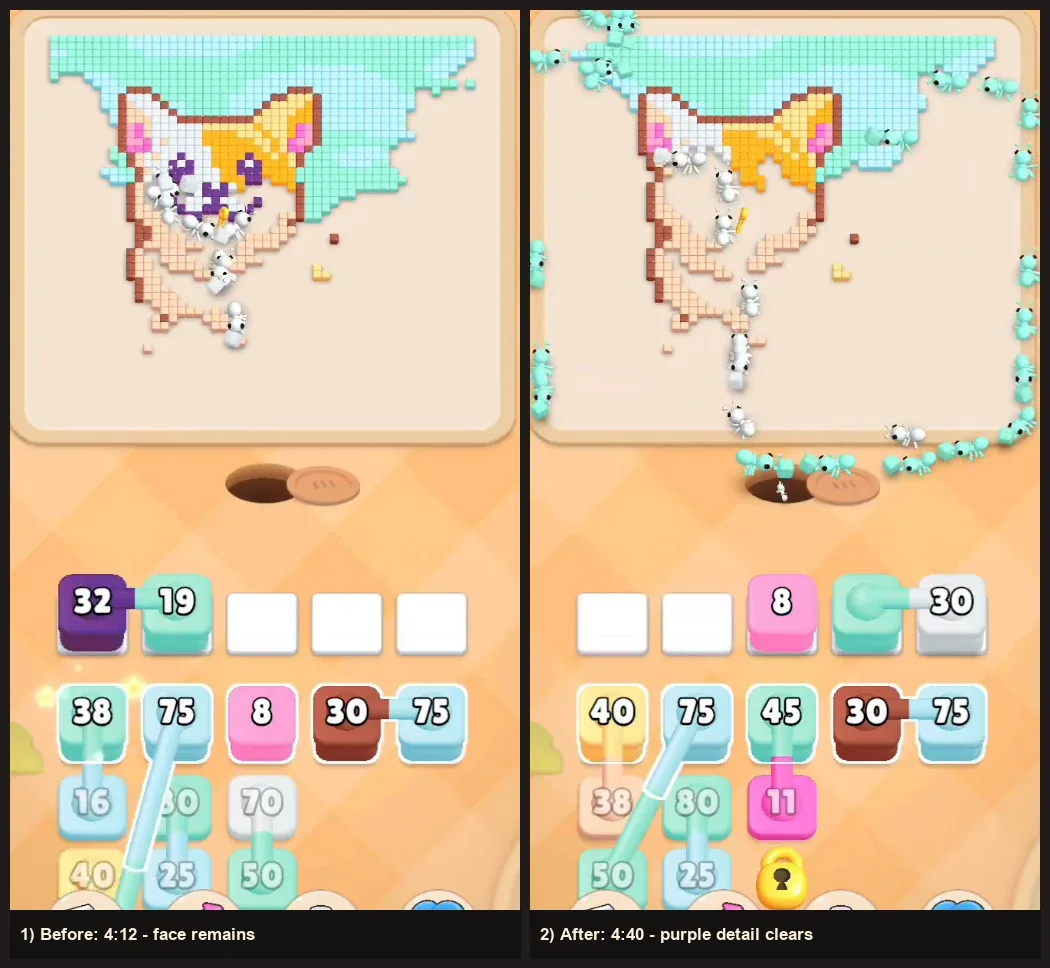
Purple and Pale teal appear together at about 4:12, and later in the window Pink and White replacements continue the face and sky cleanup. The purple eye and muzzle pixels disappear, the upper sky thins, and the orange head is left as the main large mass at about 0.32 fill.
- What to do: seat Purple the moment a slot opens.
- Why it works: Purple is a tiny board group, so burying it behind pale blocks leaves the eyes as the last pixels of the face.
- Do not: keep four pale cells running while the only Purple tray block waits.
Step 9 - Late body colours (4:40-5:45)
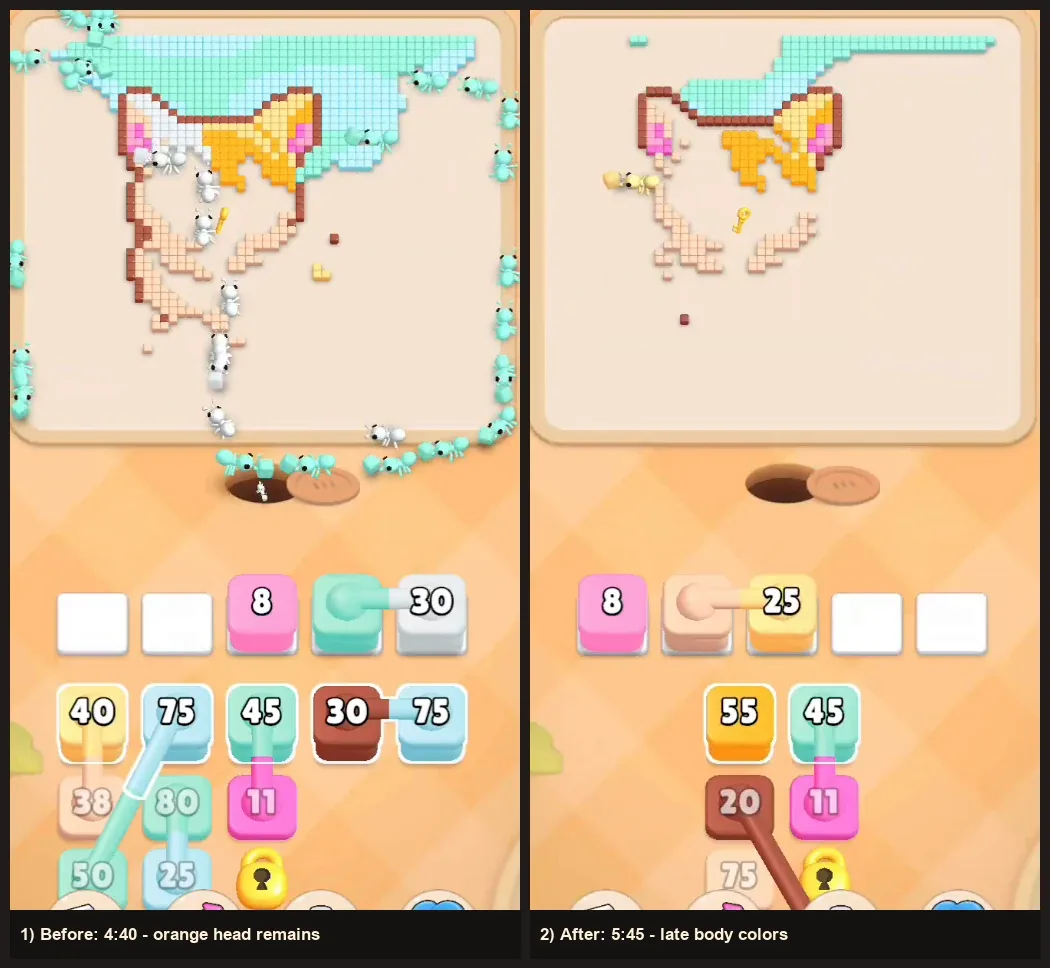
A five-seat refresh at about 4:44 uses Pink, Pale teal, White, Pale cyan and Brown. Around 5:14 the row shifts to Peach, Yellow, Pale teal and Pale cyan. The orange head, the lower body and the tail lose most of their dense colour, and fill falls from about 0.32 to 0.15.
- What to do: treat every seat change or newly lit chain end as one action.
- Why it works: the head and tail carry the last large warm masses, and Peach plus Yellow drain them fastest.
- Do not: log a new step for a long drain in an unchanged seat.
Step 10 - Final cleanup and the empty board (5:45-6:27)
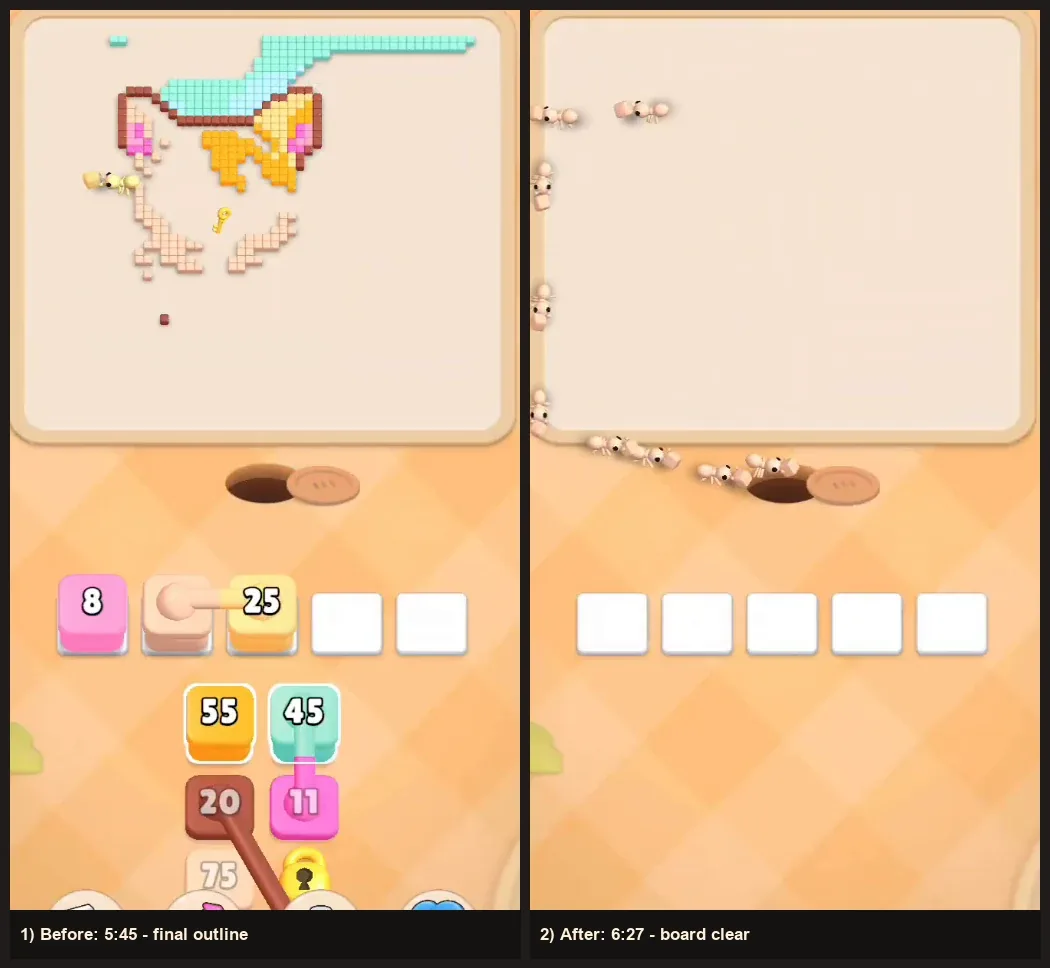
The last visible blocks are Pink, Peach, Yellow and Brown, followed by final Pale teal and Cyan seats; at 6:25 only a peach block and a pale-teal block remain in the row. The last outline and body scraps disappear, all seats go white, and fill reaches the 0.007 empty-board baseline at 6:27.
- What to do: quote 6:27 as the clear time and stop the tap list at the empty seat row.
- Why it works: the empty board is the last gameplay state; the logo and the Victory screen are overlays.
- Do not: count colours under the logo at 6:28 or the splash at 6:31 as seats.
What each colour is doing
| Colour | Role on this board |
|---|---|
| Green / Light green | Grass, lower field and the early seat wave; the most frequent green-family replacement |
| Cyan / Pale cyan / Pale teal | Turquoise sky, pale body edges and linked tray cells; the pale shades behave as close variants |
| Brown | Puppy outline and lower-left field; returns through the middle and the late cleanup |
| Yellow | Warm head and tail highlights; one of the longest-running light seats |
| Peach | Pale body and warm highlights; easy to confuse with White in small seat crops |
| White | Belly, face and bright outline; long drains are still active taps |
| Pink | Late ear and body detail; mostly appears after the white body opens |
| Purple | Eyes and face detail; a small supply, so never leave it buried |
| Red | Short accent and one repeated seat replacement; not a large board region |
Three rules that carry the level
1. Fill seats the moment they open. The opening offers only four colours, and the measured waves refill several seats at once; an idle seat wastes a colour that is already on the board. 2. Check pale and linked cells before calling them empty. White and pale cyan can look like blank slots, and a tubed cell that has no printed count is still a seat. 3. Stop at the empty board. The run clears at 6:27 with fill at 0.007; the logo at 6:28 and the Victory overlay at 6:31 are post-clear UI.
Common mistakes on level 1360
- Waiting for a five-seat opening wave when only four colours are available.
- Reading the pale seat interiors as empty squares at 0:05 and again in the pale wave at 1:15-2:00.
- Counting the airborne White blocks above seats 1 and 2 at 0:30 as seated blocks.
- Tapping a dimmed tubed cell because its colour matches the board.
- Extending the tap list into the 6:28 logo or the 6:31 Victory screen.
Quick reference
Green·Light green·Pale teal·Brown -> Brown·Red -> Light green·Pale teal·Brown·Cyan·Yellow -> Light green·Pale teal·Peach·White -> Green·Brown·Peach -> White·Pale teal·Green -> Yellow·Green·White·Red·Cyan -> Purple·Pale teal·Pink·White -> Pink·Pale teal·Brown·Peach·Yellow -> Pink·Peach·Brown·Pale teal -> clear at 6:27.
Colours in this level: Green, Light green, Pale teal, Cyan, Pale cyan, Brown, Yellow, Peach, White, Pink, Purple, Red.
The last pixels to fall are the remaining peach and pale-teal body scraps just before the empty board at 6:27.