Colony Flow Level 1460 Walkthrough & Step-by-Step Guide
Advanced
Editorial Team
Level 1460 video solution · published October 8, 2026
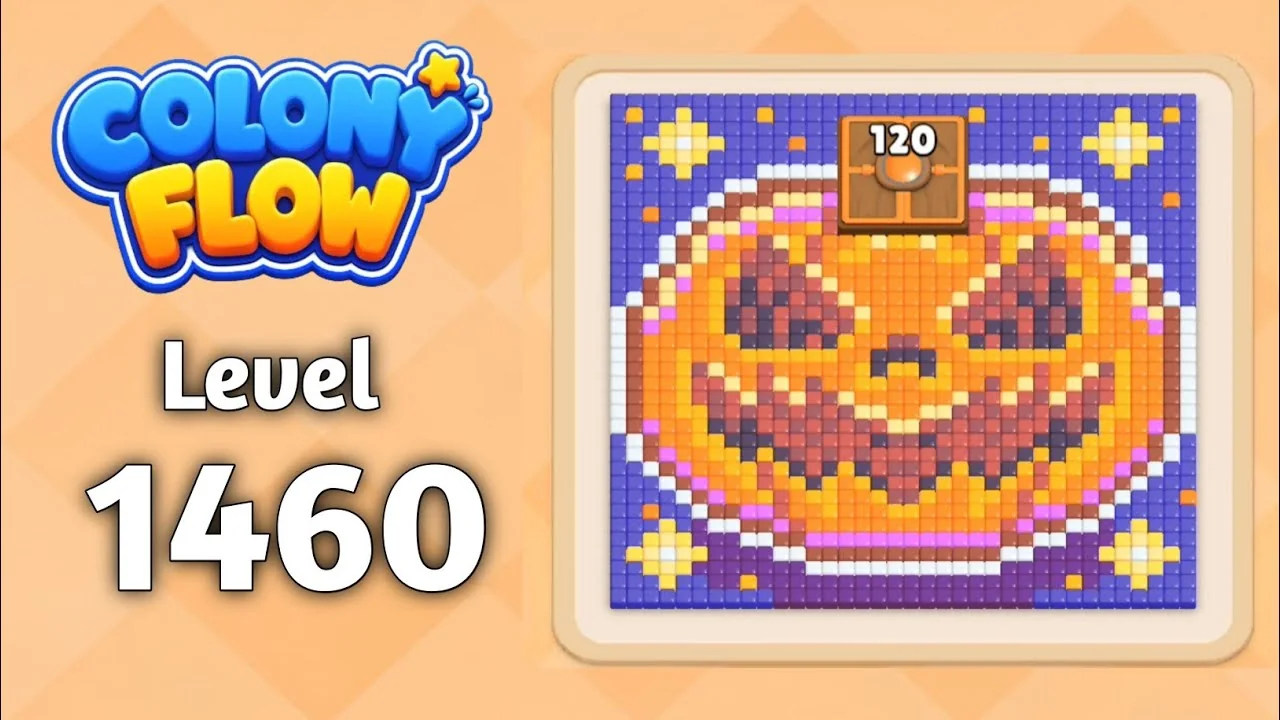
Watch on YouTube →Colony Flow Level 1460 is a pixel-art board. Measured from the board image on this page, the picture breaks down into 9 colours, each covering at least 2% of the board: red covering the most at 19.8%, then blue (18.9%) and orange (15.2%), with 6 smaller colours behind them. The cream that frames the picture reads as the board's empty background - it frames the artwork rather than forming part of it.
Level board
Illustrated walkthrough
Editorial Team
How do you beat level 1460? Watch the video or follow the step-by-step picture and text guide to complete it!
Level 1460 is an Advanced five-seat clear of a jack-o'-lantern on a deep blue field. You tap coloured blocks from the bottom tray into the seats; matching ants leave the centre hole and eat every pixel of that colour. The artwork uses Orange for the pumpkin body, Yellow for stars and highlights, Brown and Red for the carved face, White for the outline, and Purple and Pink accents around the edges. A wooden chest at the top centre starts at 120 and is a progress gate, not another colour block.
The measured clear finishes at 4:58 (empty board). The Colony Flow logo follows at 5:00 and the Victory screen at 5:03. The chest opens by 3:15 after passing 106 / 87 / 85 / 82 / 52 / 50 / 26 — read it as a progress bar for the nearby artwork, and stop the timeline at the empty board.
Level 1460 at a glance
| Detail | Level 1460 |
|---|---|
| Difficulty | Advanced |
| Seats | 5 |
| Measured seat colours | Purple, Blue, Yellow, Brown, White, Orange, Red, Charcoal, Pink |
| Special gate | Wooden chest, starts at 120, opens by 3:15 |
| Tray quirks | Linked pairs across Blue/Yellow, Yellow/Brown and late Orange/Yellow |
| Clear time | ~4:58 |
| Source run | The video solution above |
The ten-step route
| # | Time | What happens | Where it happens |
|---|---|---|---|
| 1 | 0:05-0:10 | Opening seats: Purple, Blue, Yellow and Brown | Seat row + front tray |
| 2 | 0:19-0:30 | White pair: White 12 and White 18 clear the outline | Top outline + blue field |
| 3 | 0:40-0:57 | First warm wave: Red / Orange / Yellow / Blue; chest starts down | Top edge, white trim, pink band |
| 4 | 1:00-1:37 | Five-seat middle row: Red / Charcoal / Yellow / Brown / Blue | Upper blue field + face |
| 5 | 1:50-2:18 | Row drains to Blue 23 and Yellow 15 | Lower face + warm bands |
| 6 | 2:27-2:57 | Long chest drop: linked Blue, Yellow, Orange pair | Orange centre + yellow highlights |
| 7 | 3:07-3:28 | Chest opens at 3:15, then a fresh five-seat wave | Top blue clusters + lower warm strips |
| 8 | 3:38-3:49 | Late five-seat cleanup: Brown / Pink / Red / White / Charcoal | Last blue strip + lower outline arcs |
| 9 | 4:15-4:53 | Final five-colour wave: Orange / Pink / Orange / Yellow / Blue | Isolated top and centre remnants |
| 10 | 4:55-4:58 | Last Orange / Yellow / Blue picks drain; board clear | Whole artwork + hole |
Mnemonic: Purple·Blue·Yellow·Brown -> Blue·Yellow·Brown·White·White -> Blue·Yellow·Orange·Yellow·Purple -> Red·Charcoal·Yellow·Brown·Blue -> Blue·Yellow -> Blue·Yellow·Orange -> chest gone -> Brown·Pink·Red·White·Charcoal -> Orange·Pink·Orange·Yellow·Blue -> clear.
Step 1 - First seats fill (0:05-0:10)
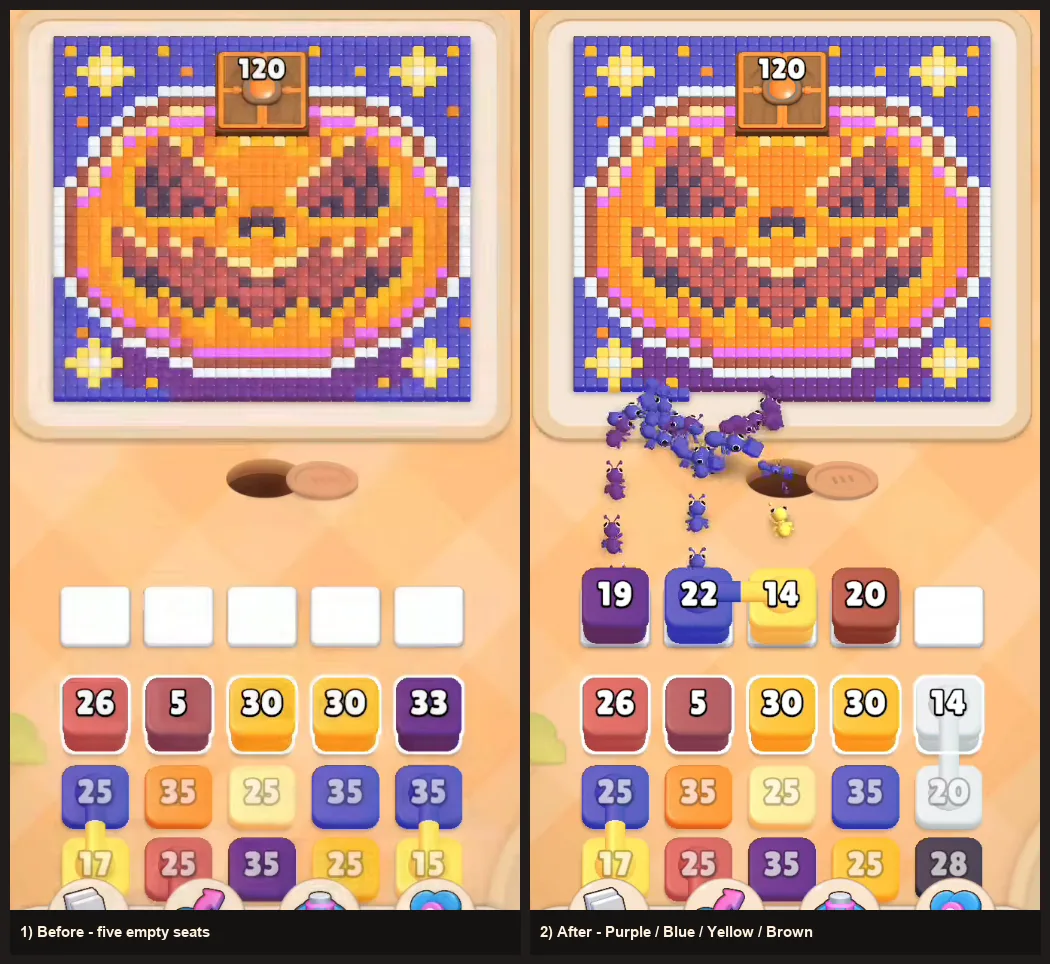
The playfield opens with five empty seats and the full tray. By 0:10 the row holds Purple 19, Blue 22, Yellow 14 and Brown 20; seat 5 remains empty. The jack-o'-lantern is still intact and the chest still reads 120. Ants begin leaving the hole and the front tray cells leave their starting positions.
- What to do: take the lit opening blocks and let the fifth seat refill.
- Why it works: Blue 22 and Purple 19 start on the largest background regions immediately.
- Do not: use brightness alone to read the pale Yellow block — the printed count proves it is a pick.
Step 2 - White pair clears the outline (0:19-0:30)
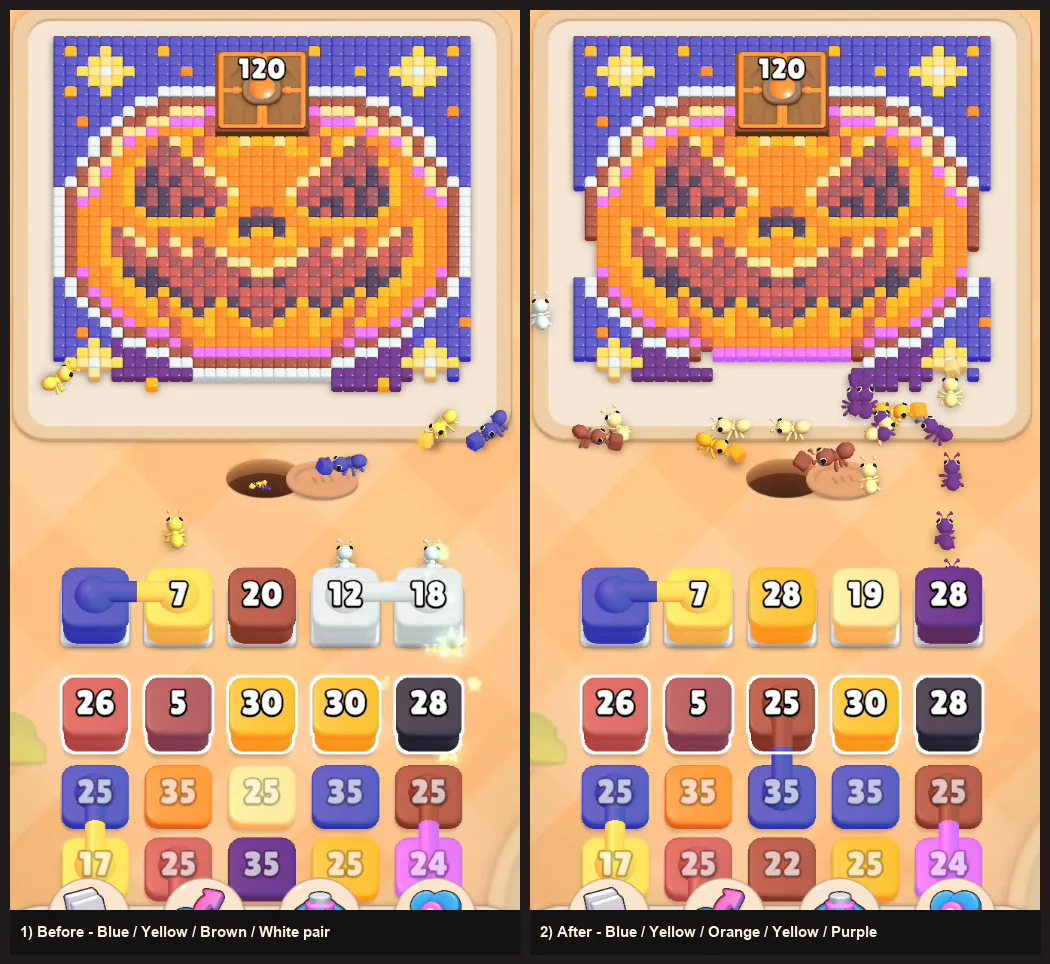
At 0:19 all five seats are occupied: a linked Blue block, Yellow 7, Brown 20, White 12 and White 18. By 0:30 the row has changed to the linked Blue block, Yellow 7, Orange 28, Yellow 19 and Purple 28. The two White blocks attack the pale border around the pumpkin; fill falls from 0.876 to 0.858.
- What to do: seat both White blocks — together they clear the entire pale outline band.
- Why it works: the outline is a thin, connected ring, so White ants finish it quickly.
- Do not: read a White block as an empty seat. Empty seats are white too; the printed counts prove occupancy.
Step 3 - Chest starts its countdown (0:40-0:57)
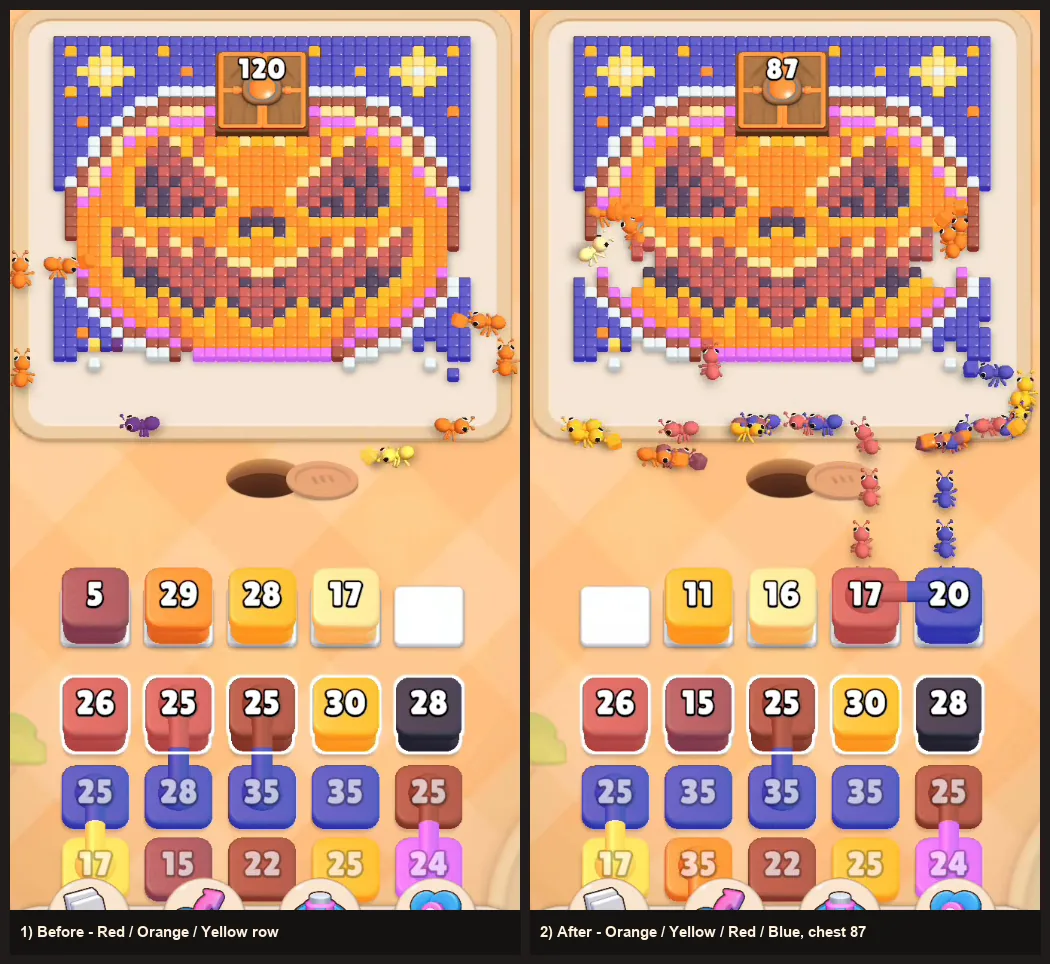
The warm row at 0:40 reads Red 5, Orange 29, Orange 28 and Yellow 17. By 0:57 it becomes Orange 11, Yellow 16, Red 17 and Blue 20. The top edge, white trim and pink horizontal band lose pixels; the chest passes 106 at 0:47 and reaches 87 at 0:57, while fill moves from 0.824 to 0.809.
- What to do: double-seat Orange when two cells are lit — this is the dense pumpkin body.
- Why it works: the chest ticks down as the top cluster clears, confirming the picks are on target.
- Do not: treat the chest as a colour to seat; it is a progress gate.
Step 4 - Five-seat middle row (1:00-1:37)
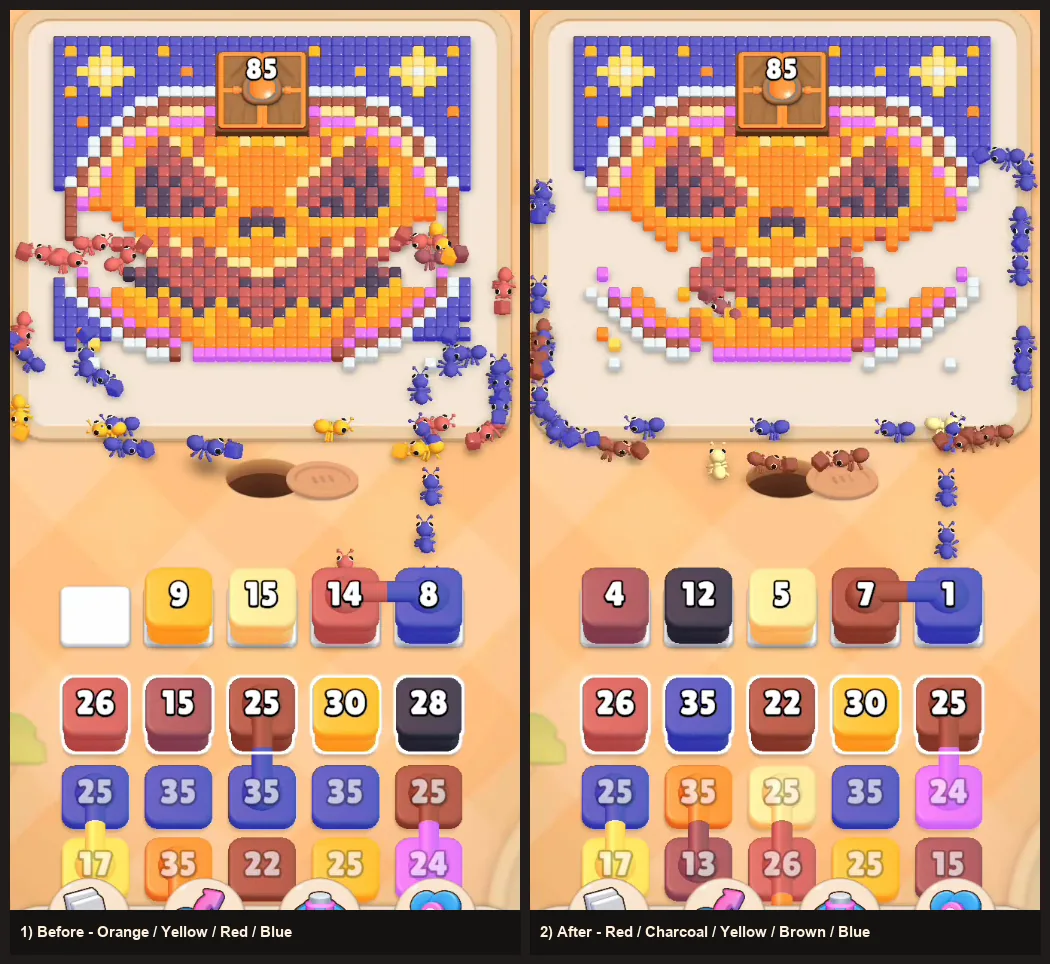
At 1:00 the useful seats are Orange, Yellow, Red and Blue. By 1:37 the row holds Red, Charcoal 12, Yellow, Brown and Blue. The upper blue field and the warm face bands begin to open; fill falls from 0.815 to 0.695 while the chest holds at 85.
- What to do: keep all five seats moving — this is the widest wave of the early clear.
- Why it works: five different colours hit five different regions at once.
- Do not: mistake Charcoal for a hole in the tray; its white printed count keeps the square readable.
Step 5 - Five seats drain to Blue and Yellow (1:50-2:18)
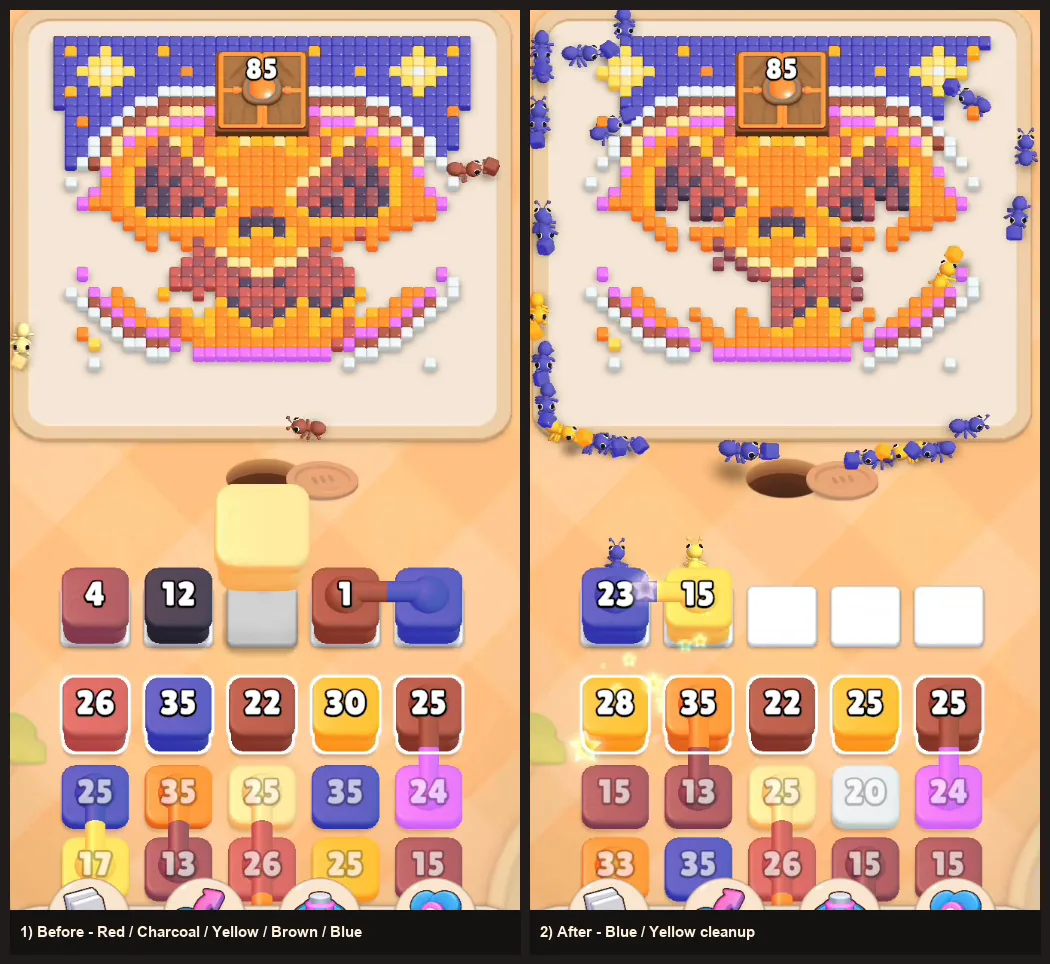
The five-seat row continues through Red, Charcoal, Yellow, Brown and Blue. By 2:18 only Blue 23 and Yellow 15 remain. The lower face and warm bands become thinner, several large cream gaps appear inside the pumpkin, and fill falls from 0.678 to 0.608.
- What to do: refill the three empty seats with lit front-row cells as soon as they unlock.
- Why it works: two long drains keep the board moving, but three idle seats waste the window.
- Do not: log a long drain as several taps — one block falling from 23 to 0 is one seat event.
Step 6 - Chest drops through 50 (2:27-2:57)
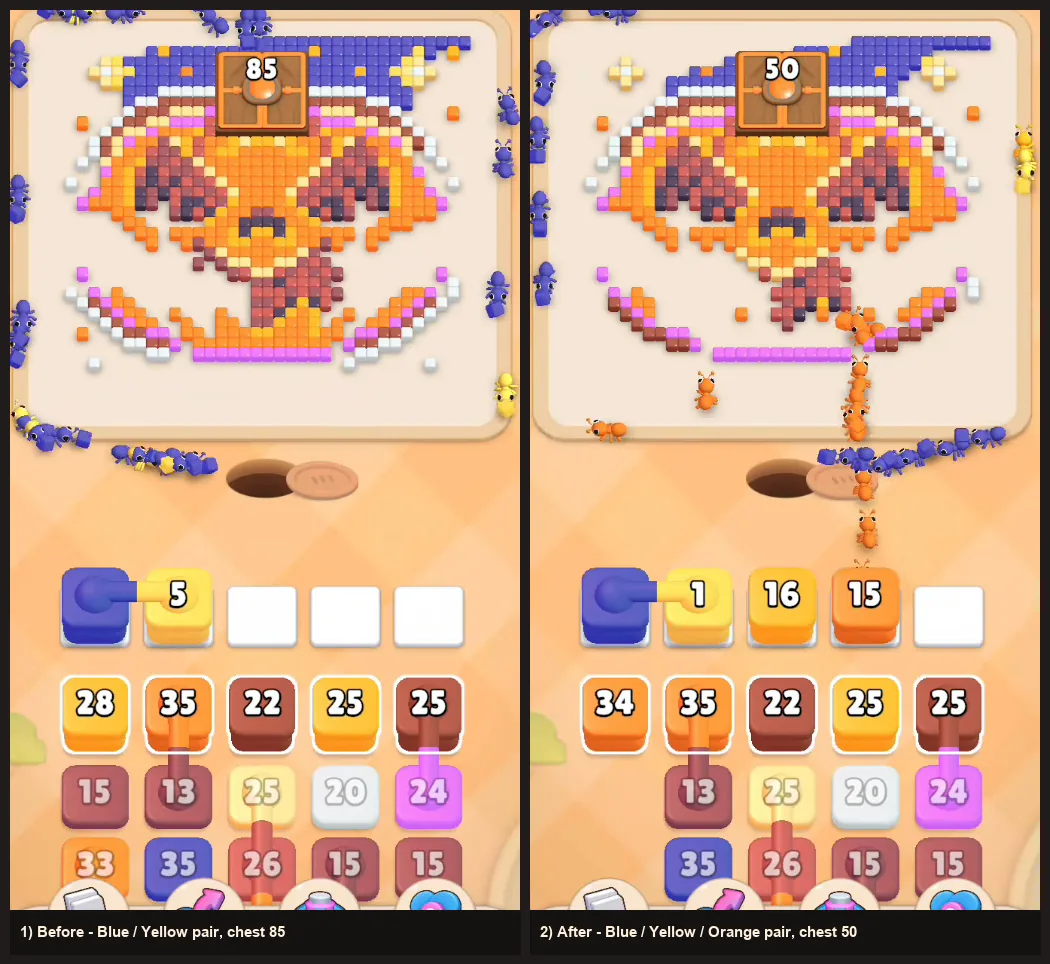
A linked Blue block and Yellow 5 hold the first two seats at 2:27. By 2:57 the row has the linked Blue block, Yellow 1, Orange 16 and Orange 15. The orange centre and yellow highlights lose large sections; the chest moves through 82, 52 and 50, and fill falls from 0.562 to 0.496.
- What to do: fill both available Orange cells instead of waiting for one long drain to finish.
- Why it works: Orange is the largest artwork group on this board; two Orange drains are the fastest middle-game progress.
- Do not: wait for Yellow 5 to finish before seating the Oranges.
Step 7 - Chest opens and the wave refreshes (3:07-3:28)
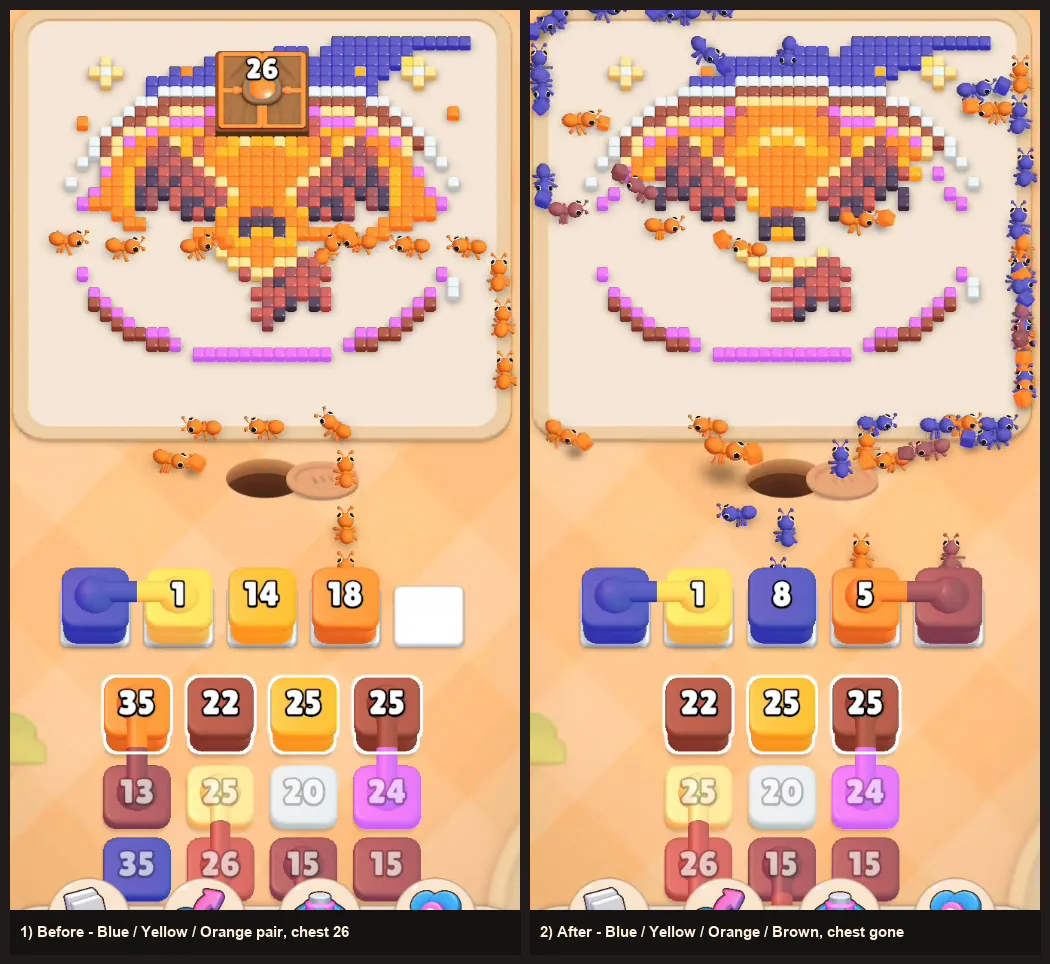
At 3:07 the seated colours are the linked Blue block, Yellow 1, Orange 14 and Orange 18, and the chest reads 26. By 3:28 the row holds linked Blue, Yellow 1, Blue 8, Orange 5 and a linked Brown block. The chest disappears by 3:15; fill falls from 0.482 to 0.429.
- What to do: after the chest opens, keep seating the normal Blue, Yellow, Orange and Brown cells that remain.
- Why it works: the gate is gone — the clear now depends only on the leftover artwork colours.
- Do not: invent a chest block or look for a chest colour; once it opens it leaves the board.
Step 8 - Late five-seat cleanup (3:38-3:49)
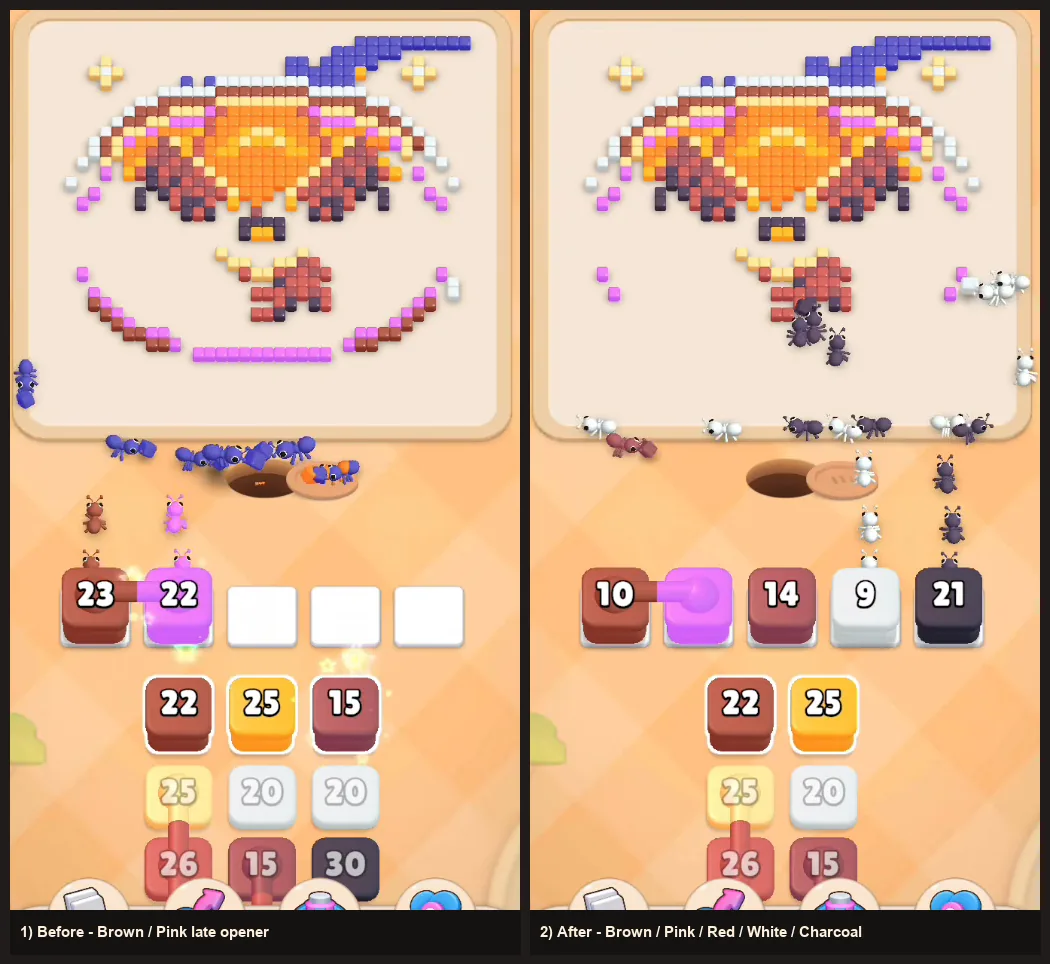
The late wave starts with Brown 23 and Pink 22. By 3:49 all five seats are active: Brown 10, Pink, Red 14, White 9 and Charcoal 21. The last blue strip and the lower outline arcs shrink; fill falls from 0.356 to 0.320.
- What to do: read Pink and Red as different families — the bright magenta block is Pink, the muted brick block is Red.
- Why it works: five short picks all target the final outline and edge remnants.
- Do not: assume the pale White 9 seat is empty; its count proves occupancy.
Step 9 - Final five-colour wave (4:15-4:53)
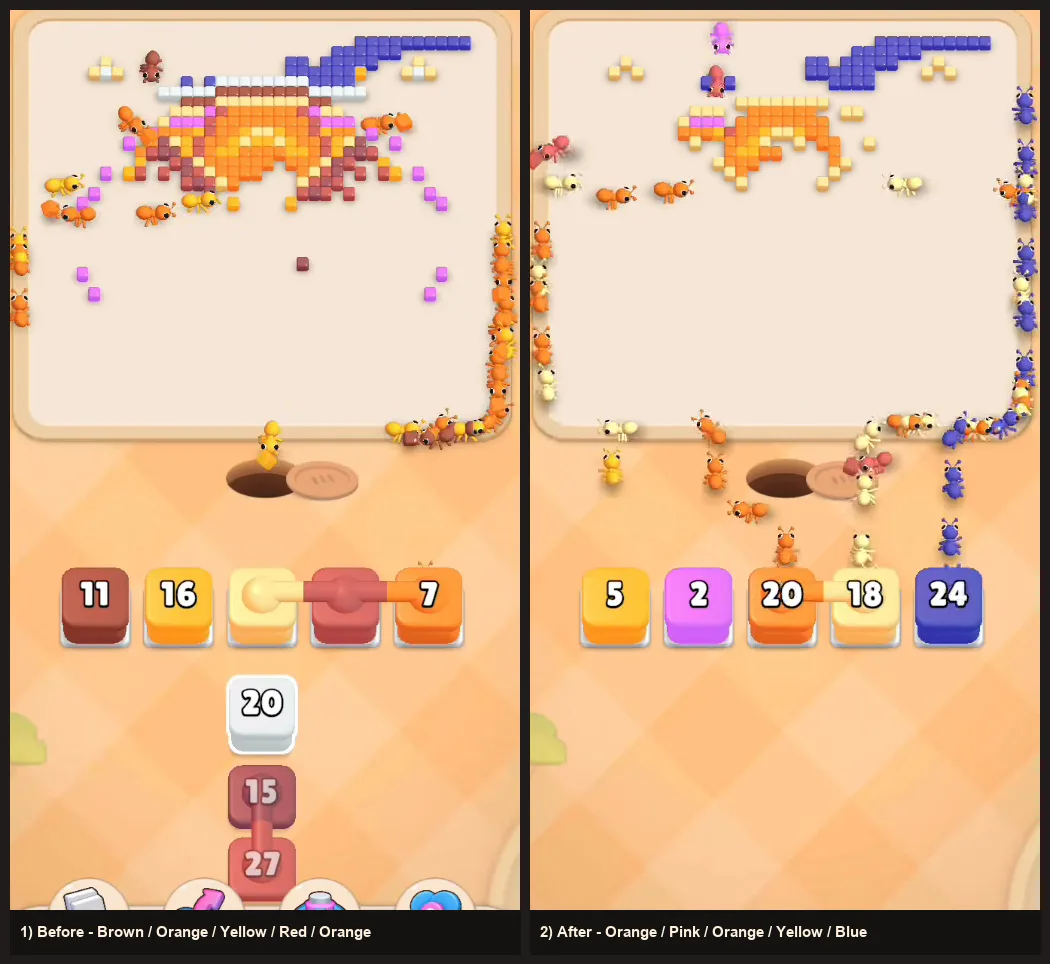
At 4:15 the row holds Brown 11, Orange 16, a linked Yellow cell, Red and Orange 7. By 4:53 it changes to Orange 5, Pink 2, Orange 20, Yellow 18 and Blue 24. Only isolated orange, yellow, blue and pink remnants remain; fill falls from 0.232 to 0.127.
- What to do: take the free lit end of the linked Orange/Yellow cells first and the partner when the tube unlocks.
- Why it works: the final remnants are small connected patches that these exact colours match.
- Do not: skip Blue 24 — the blue field is the most persistent late edge colour on this board.
Step 10 - Empty seats and clear board (4:55-4:58)
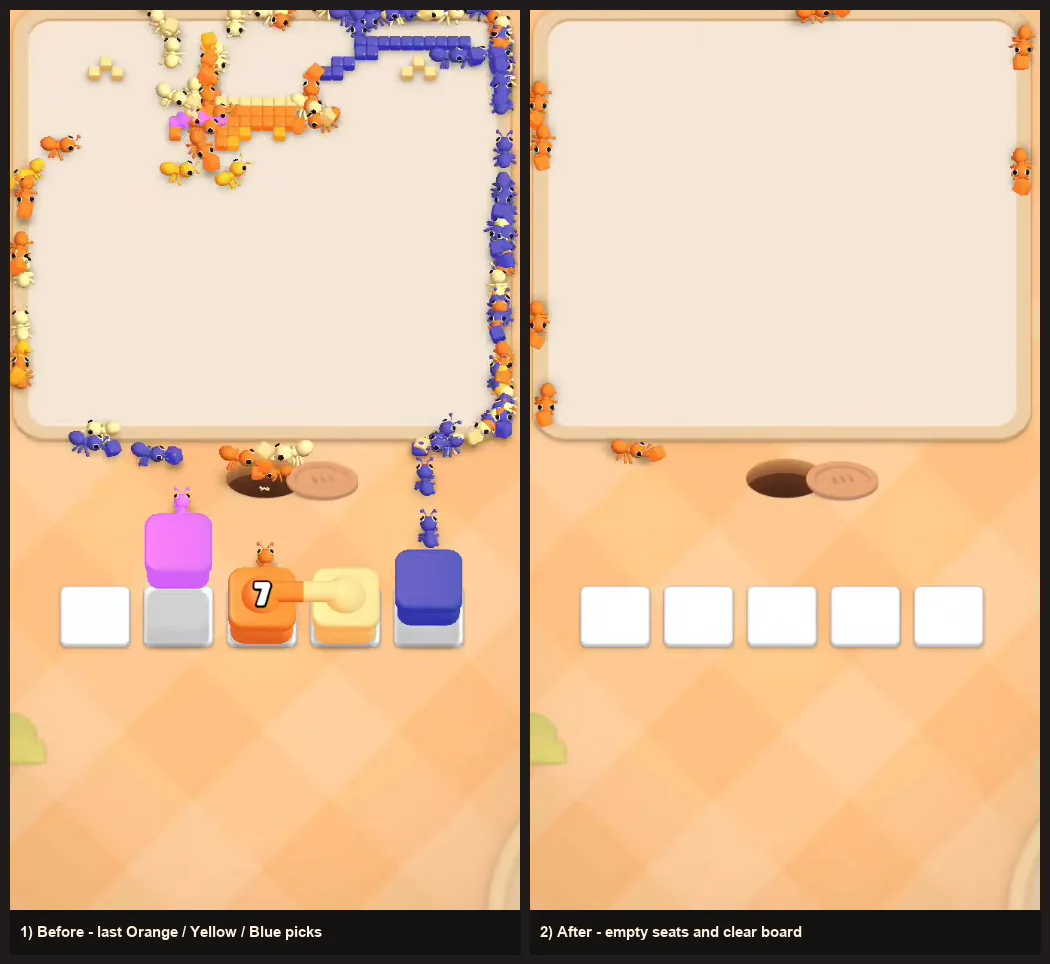
At 4:55 the row still holds Orange 7, its linked Yellow partner and the draining Blue block that showed 24 at 4:53; the first two seats are already empty. The final Orange, Yellow and Blue pixels disappear, fill drops from 0.111 to 0.000, and all five seats return to plain White.
- What to do: quote 4:58 as the clear time and stop the tap list there.
- Why it works: the empty board is the final gameplay state.
- Do not: count the Colony Flow logo at 5:00 or the Victory screen at 5:03 as seat events.
What each colour is doing
| Colour | Role on this board |
|---|---|
| Orange | Largest artwork group: the pumpkin body and broad face panels; returns in many seat waves |
| Yellow | Stars, highlights and pale face pixels; pale Yellow is a real block, not an empty seat |
| Brown | Carved face shadows and deep warm details; short Brown blocks remove dense patches |
| Red | Muted brick-red face bands; distinct from the brighter Pink blocks |
| Purple | Lower corners, deep edge pixels and linked early blocks |
| Blue | Large background field and the most persistent late edge colour |
| White | Pumpkin outline and pale trim; use the printed count to prove occupancy |
| Pink | Bright magenta trim around the pumpkin and small late remnants |
| Charcoal | Eye, mouth and darkest face details; white count text makes it easy to spot |
Three rules that carry the level
1. Keep the seat row moving. The strongest fill drops occur while four or five seats are occupied — refill empty cells with the lit front-row blocks. 2. Respect linked cells. Linked pairs appear across several colours, including Blue/Yellow, Yellow/Brown and late Orange/Yellow. Only the free lit end is tappable until its partner unlocks. 3. Read the chest as progress. It moves 120 -> 106 -> 87 -> 85 -> 82 -> 52 -> 50 -> 26 -> gone by 3:15; seat the colours that clear the nearby artwork.
Common mistakes on level 1460
- Reading White or pale Yellow blocks as empty seats.
- Treating the wooden chest as a colour to seat instead of a progress gate.
- Logging every tick of Blue 23 or Orange 29 as a new tap.
- Calling the muted brick-red blocks Pink, or the magenta blocks Red.
- Counting the 5:00 logo or the 5:03 Victory colours as gameplay states.
Quick reference
Purple·Blue·Yellow·Brown -> Blue·Yellow·Brown·White·White -> Blue·Yellow·Orange·Yellow·Purple -> Red·Charcoal·Yellow·Brown·Blue -> Blue·Yellow -> Blue·Yellow·Orange -> chest gone -> Brown·Pink·Red·White·Charcoal -> Orange·Pink·Orange·Yellow·Blue -> clear at 4:58.
Colours in this level: Purple, Blue, Yellow, Brown, White, Orange, Red, Charcoal, Pink.
The very last pixels to fall are Orange, Yellow and Blue remnants just before 4:58.