Colony Flow Level 1420 Walkthrough & Step-by-Step Guide
Advanced
Editorial Team
Level 1420 video solution · published October 7, 2026
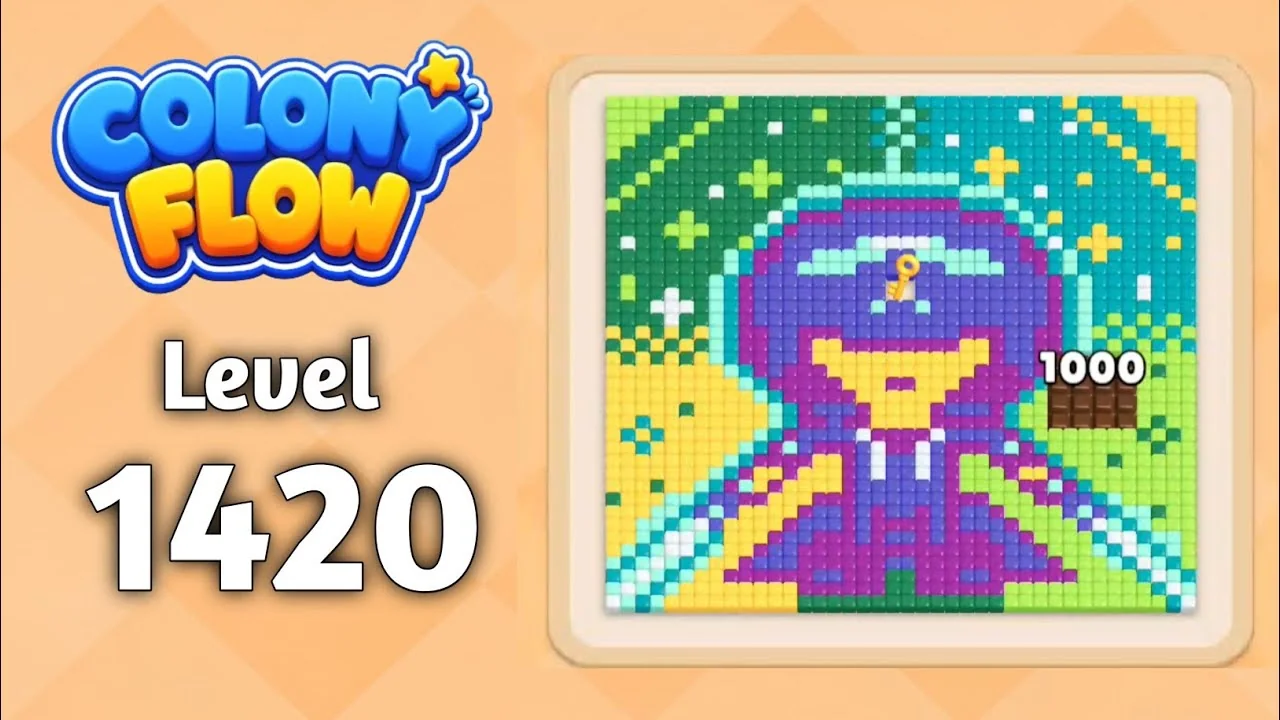
Watch on YouTube →Colony Flow Level 1420 is a pixel-art board. Measured from the board image on this page, the picture breaks down into 8 colours, each covering at least 2% of the board: yellow covering the most at 12.8%, then dark cyan (12.8%) and dark green (12.6%), with 5 smaller colours behind them. The cream that frames the picture reads as the board's empty background - it frames the artwork rather than forming part of it.
Level board
Illustrated walkthrough
Editorial Team
How do you beat level 1420? Watch the video or follow the step-by-step picture and text guide to complete it!
Level 1420 is an Advanced five-seat clear of a purple pixel creature on cream, framed by a green foliage-like upper and side field. You tap coloured blocks from the bottom tray into the seats; matching ants leave the centre hole and eat every pixel of that colour. The artwork is built from Green and Light green leaves, a Teal and Pale cyan wing field, a Blue deep-wing region, a Purple face and outline, a Yellow chest patch, White pale trim, and small Orange face accents. A wooden chest badge on the right side of the artwork starts at 1000 and counts down as the nearby pixels fall - a progress gate, not a seat colour.
The measured clear finishes at 4:29 (empty board, fill 0.1064 on the full crop). The Colony Flow logo arrives at 4:30 and the Victory overlay at 4:33, and neither belongs in the tap timeline. The clear runs as clusters of three or four colours rather than full five-seat waves, and two blocks in the middle and late frames are airborne rather than seated.
Level 1420 at a glance
| Detail | Level 1420 |
|---|---|
| Difficulty | Advanced |
| Seats | 5 |
| Measured seat colours | Green, Light green, Teal, Pale cyan, Blue, Purple, Yellow, White |
| Special gate | Wooden chest, 1000 down to 3, opens at 3:17 |
| Tray quirks | Teal/Pale cyan and Green/Light green pairs are easy to confuse; blocks can hover above seats |
| Clear time | ~4:29 |
| Source run | The video solution above |
The ten-step route
| # | Time | What happens | Where it happens |
|---|---|---|---|
| 1 | 0:04-0:20 | Light green, Green and Yellow take the front seats | Upper foliage + left field |
| 2 | 0:20-0:40 | Teal and Pale cyan join White and Blue | Wing edges + upper-left highlights |
| 3 | 0:40-1:00 | Blue and Teal drain the upper wing | Upper wing + face rim |
| 4 | 1:00-1:20 | Purple leads a four-seat phase | Centre face + left wing |
| 5 | 1:20-2:00 | Blue, Pale cyan, Purple and Green hold the centre | Central face + lower body |
| 6 | 2:00-2:40 | A Blue pair works beside Purple | Centre + lower face |
| 7 | 2:40-3:20 | Teal pair, then the chest badge disappears | Lower side fields + chest |
| 8 | 3:20-4:00 | Blue, White, Light green, Purple, Pale cyan thin the sides | Upper frame + right side + lower centre |
| 9 | 4:00-4:20 | Green, Light green and Yellow finish the islands | Last large islands + lower centre |
| 10 | 4:26-4:29 | The final Yellow chain clears the board | Bottom tray + whole artwork |
Mnemonic: Green·Green·Yellow·Light green -> Teal·Pale cyan·White·Blue -> Blue·Teal -> Purple·Teal·Light green·Pale cyan -> Blue·Pale cyan·Purple·Green -> Pale cyan·Purple·Blue·Blue -> Teal pair, then Blue·Light green·Teal -> Blue·White·Light green -> Green·Light green·Yellow -> Yellow pair -> clear at 4:29.
Step 1 - Opening Green cluster (0:04-0:20)
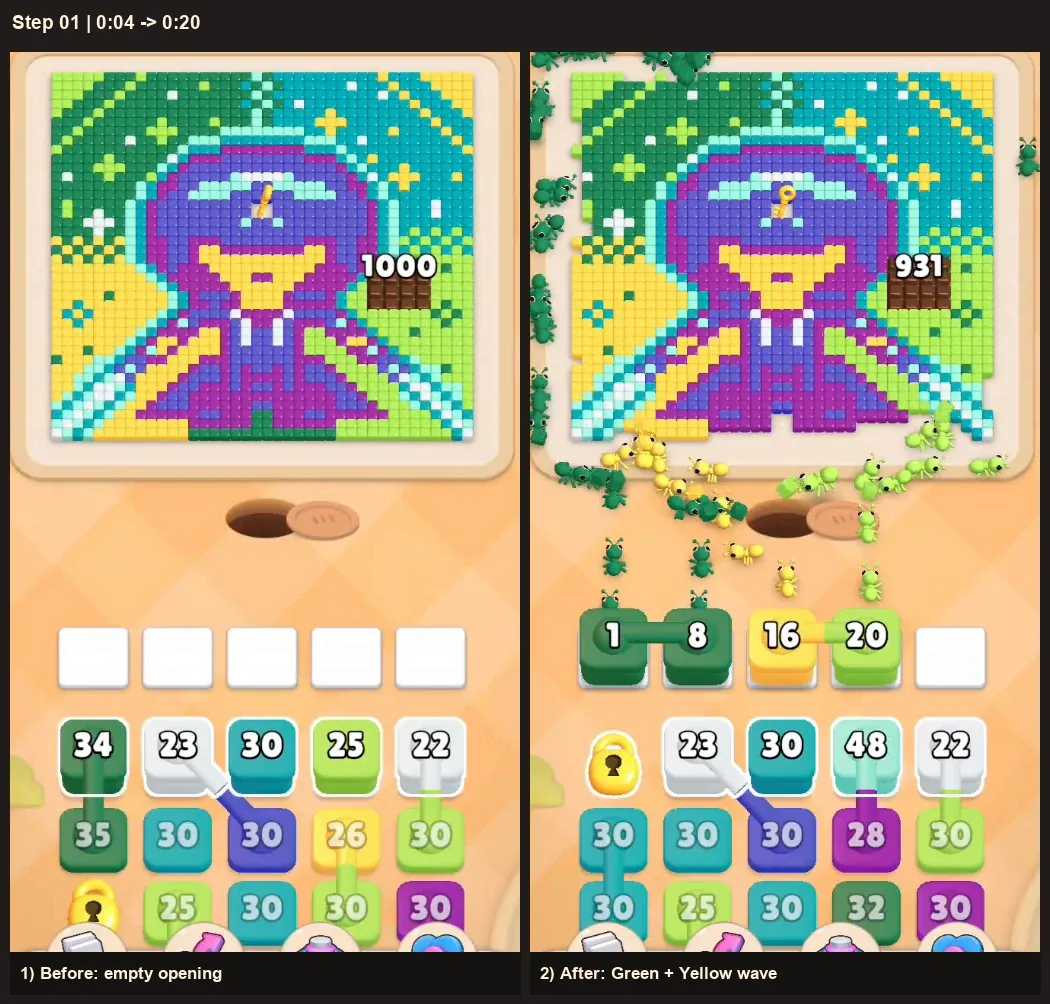
At 0:09 the first stable cluster shows Light green, Green and Green on seats 1-3. By 0:17 seat 1 turns Green and seat 4 takes Light green; seat 3 changes to Yellow at 0:19. The end-of-window row is Green / Green / Yellow / Light green / empty. Fill only moves 0.8768 to 0.8704 while the chest falls from 1000 to 931.
- What to do: seat the three green-family blocks together and start on the upper foliage.
- Why it works: the opening offers four seats' worth of colours but they are all part of one field, so they drain as one region.
- Do not: count the moving Light green block at 0:05 as a tap - wait for the stable 0:09 state.
Step 2 - Teal, Pale cyan, White and Blue (0:20-0:40)
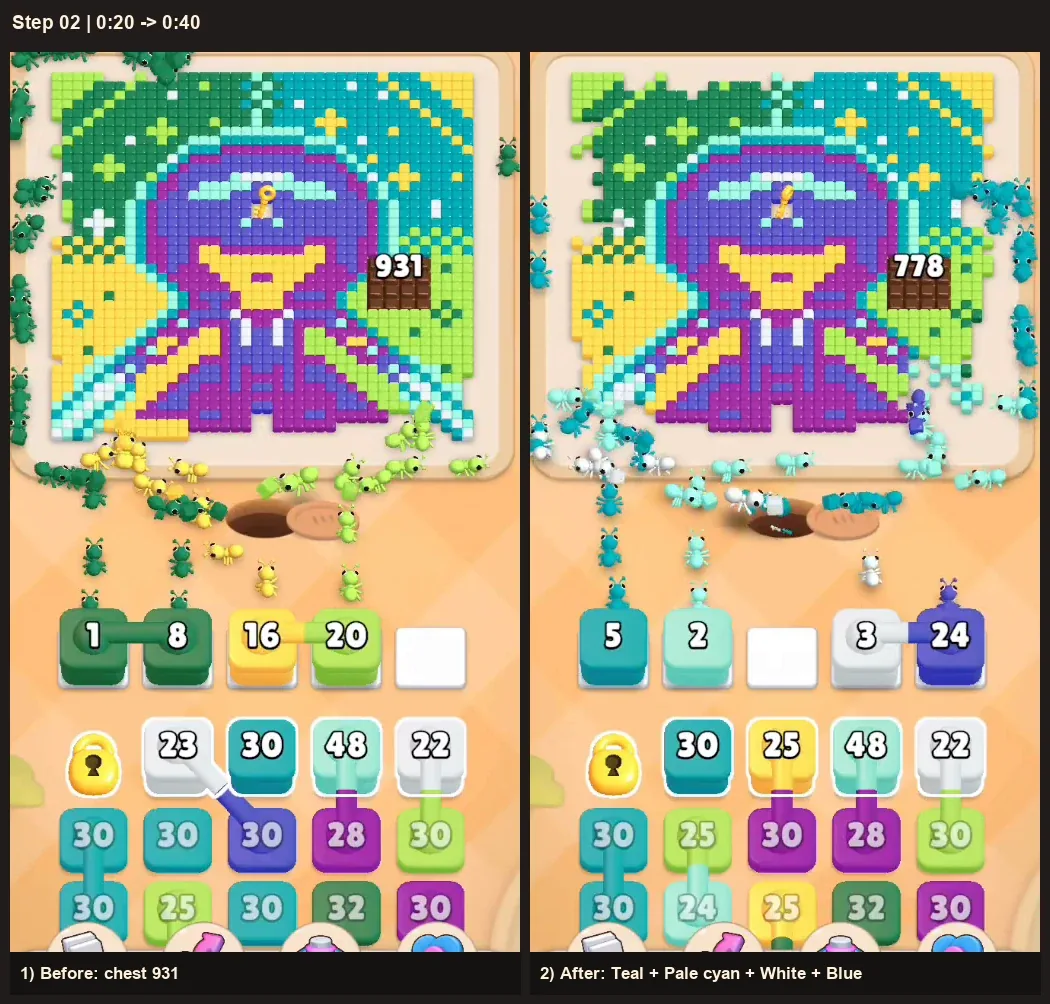
Seat 5 takes Teal at 0:22, seat 3 becomes Teal at 0:26 and seat 5 turns Blue the same second. The 0:33 wave puts Teal on seat 1, Pale cyan on seat 2 and a counted White block on seat 4. The stable 0:40 state is Teal / Pale cyan / empty / White / Blue, with fill at 0.8229 and the chest at 778.
- What to do: treat the counted White block on seat 4 as occupied and keep it draining the pale trim.
- Why it works: Teal and Pale cyan cover the wing edges while White works the pale highlights, so all three regions open in parallel.
- Do not: let the tracker's grey-white reading turn the White block into a false Pale cyan - check the printed count.
Step 3 - Blue and Teal drain (0:40-1:00)
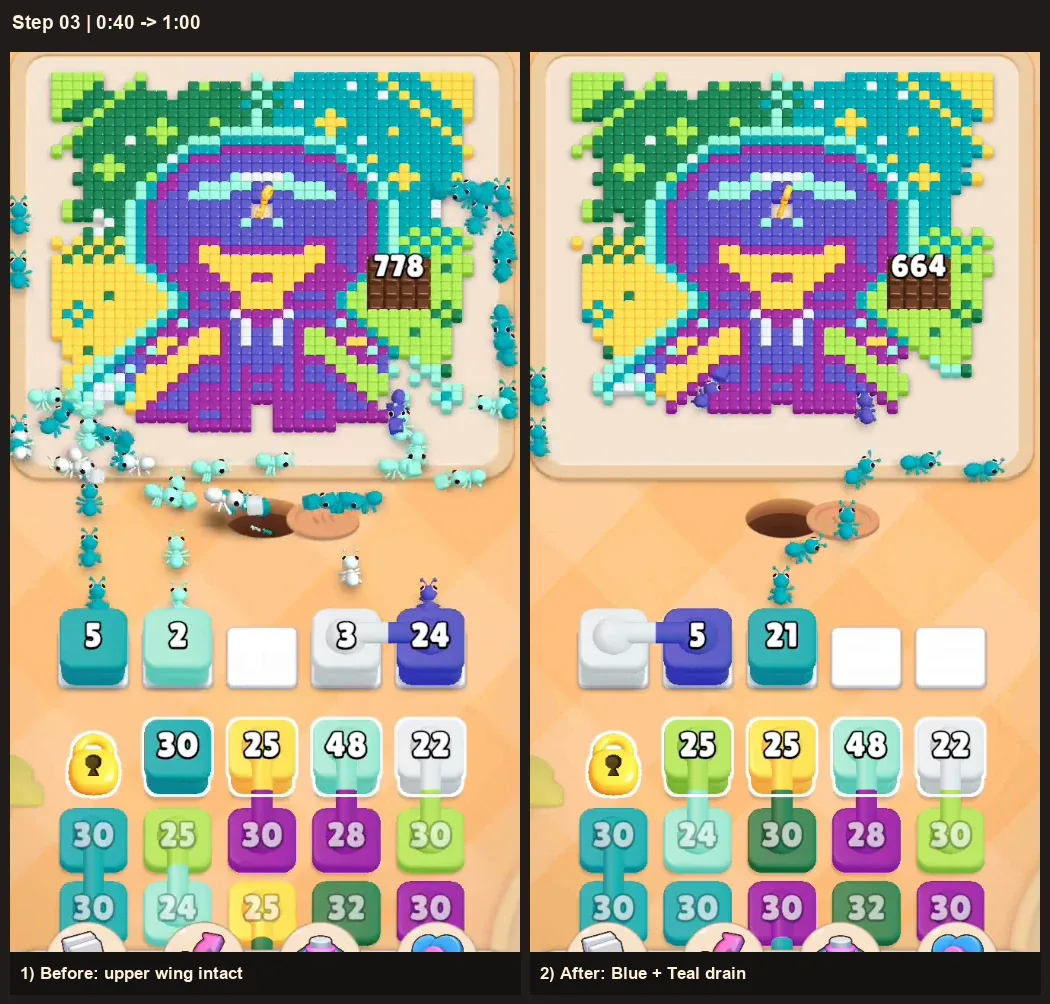
Seat 2 takes Blue and seat 3 takes Purple at 0:43; seat 4 takes Yellow at 0:44. By 0:58 seat 2 is Blue again and seat 3 settles on Teal. At 1:00 only seats 2-3 remain occupied: empty / Blue / Teal / empty / empty, with fill at 0.7442 and the chest at 664.
- What to do: let the Blue and Teal pair finish the wing opening before refilling other seats.
- Why it works: the upper wing is a single large teal-blue mass, and two matching seats drain it fastest.
- Do not: log the one-frame Purple flicker at 0:43 as a stable seat - anchor the narrative to end-of-window states.
Step 4 - Purple-led four-seat phase (1:00-1:20)
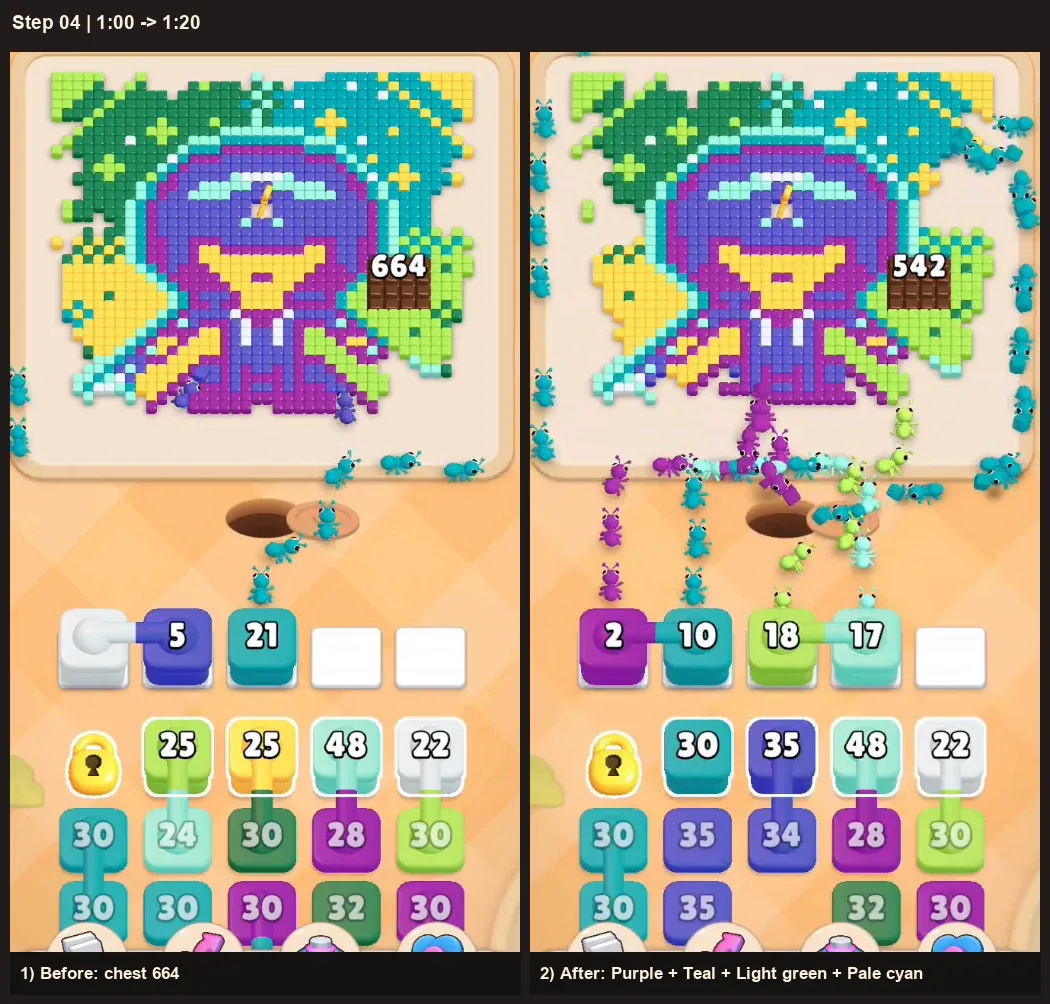
Seat 5 takes Green at 1:02 and seat 4 takes Yellow at 1:03. At 1:12 seats 1-2 become Purple / Teal, and at 1:18 seats 3-4 take Light green / Pale cyan. The stable 1:20 row is Purple / Teal / Light green / Pale cyan / empty, with fill at 0.7152 and the chest at 542.
- What to do: keep all four seats working - Purple is the largest visible block but not the only useful one.
- Why it works: the central face needs Purple while the left wing and lower edge need the two greens and the pale cyan.
- Do not: drop the Light green and Pale cyan support seats just because Purple dominates the frame.
Step 5 - Blue, Pale cyan, Purple, Green (1:20-2:00)
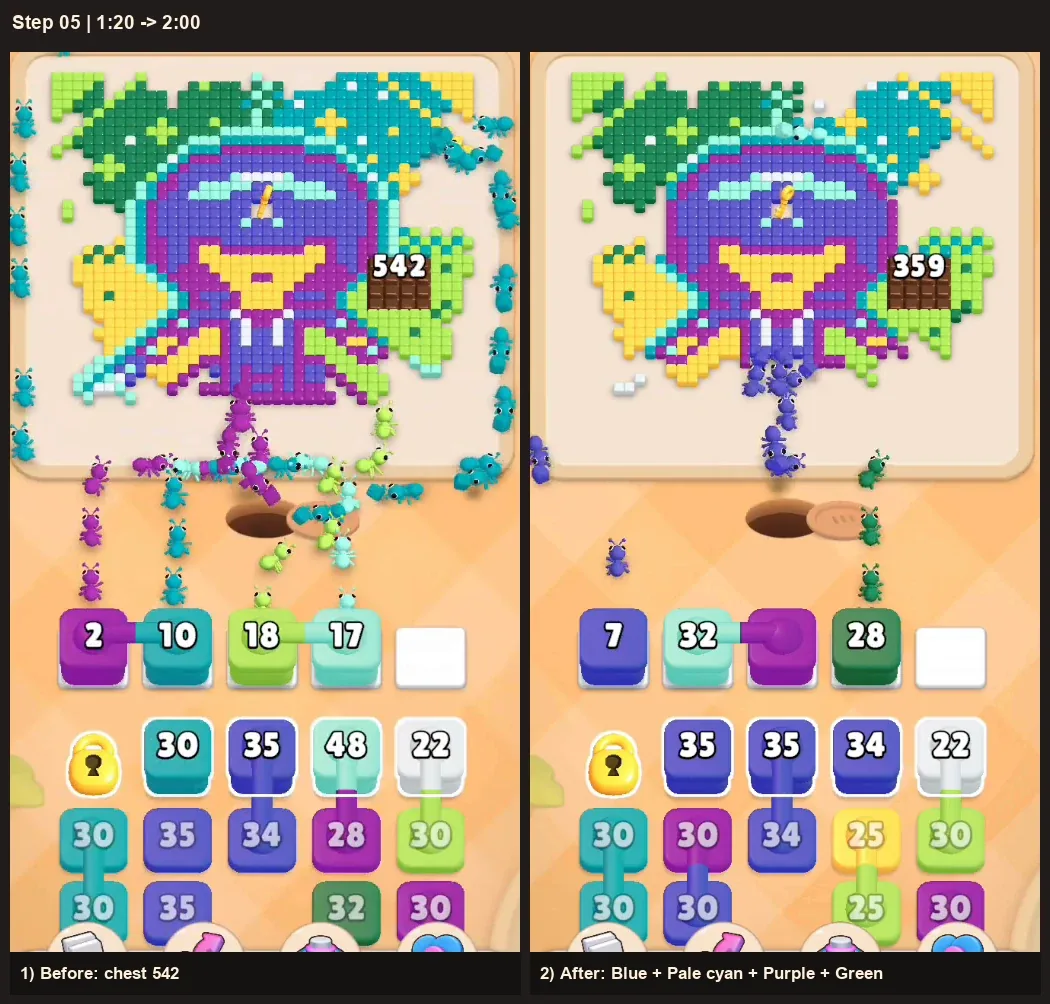
Seat 1 takes Teal at 1:30, seat 3 takes Purple at 1:38, seat 1 turns Blue at 1:51 and seat 4 takes Green at 1:59. Pale cyan holds on seat 2 throughout. The 2:00 state is Blue / Pale cyan / Purple / Green / empty, with fill at 0.6200 and the chest at 359.
- What to do: trust the enlarged frames when the tracker flickers between Teal and Pale cyan on seat 2.
- Why it works: Pale cyan holds across the whole window, so one long drain is doing the work of several apparent swaps.
- Do not: count a long drain in an unchanged seat as a new step.
Step 6 - Blue pair and Purple (2:00-2:40)
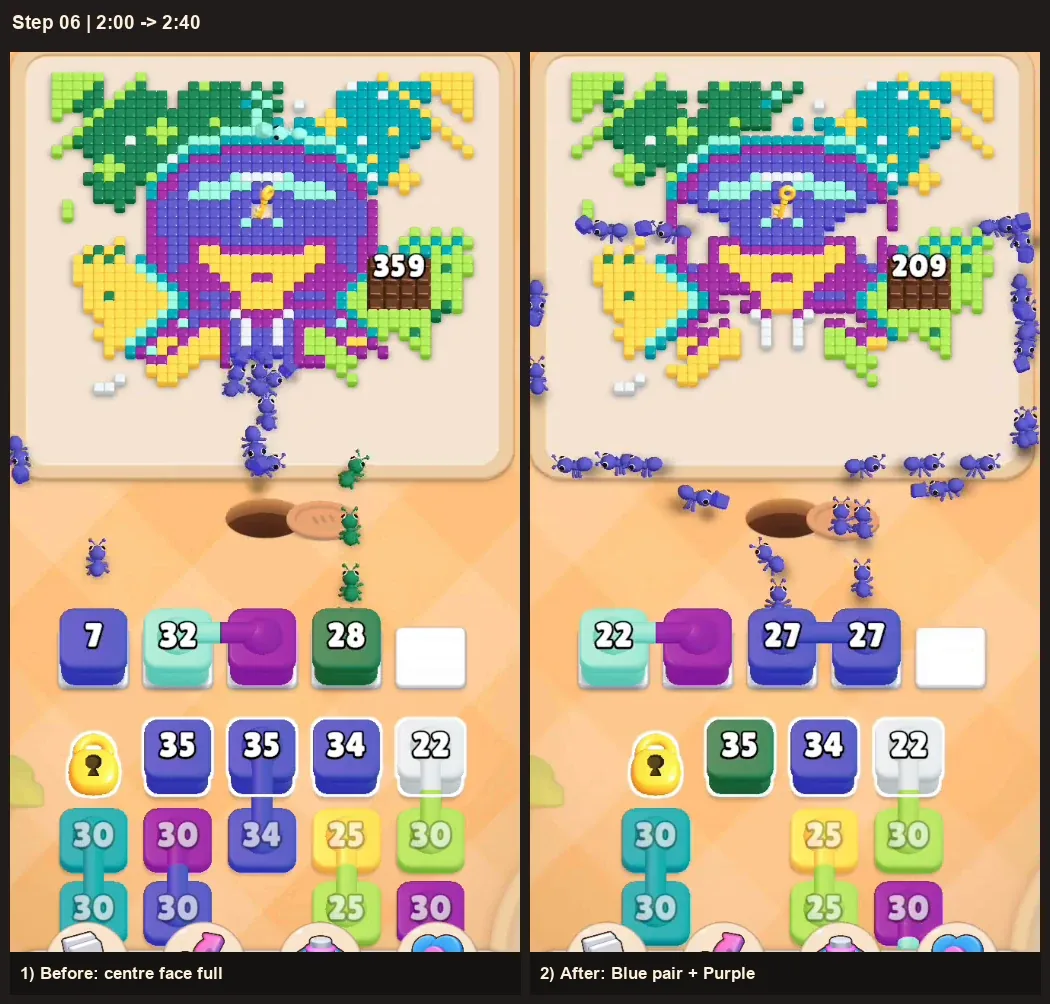
Seat 1 stays Blue through 2:07; at 2:13 seat 4 becomes Purple and seat 5 takes Blue. The 2:39 wave puts Pale cyan on seat 1, Purple on seat 2 and Blue on seats 3-4. The stable 2:40 row is Pale cyan / Purple / Blue / Blue / empty, with fill at 0.5707 and the chest at 209.
- What to do: keep both Blue seats supplied so the pair drains the lower blue field as one region.
- Why it works: the Blue pair on seats 3-4 is the strongest mid-level signal and covers the deepest wing field.
- Do not: interrupt the Blue pair for a small edge colour while the deep field is still half full.
Step 7 - Teal pair and the chest gone (2:40-3:20)
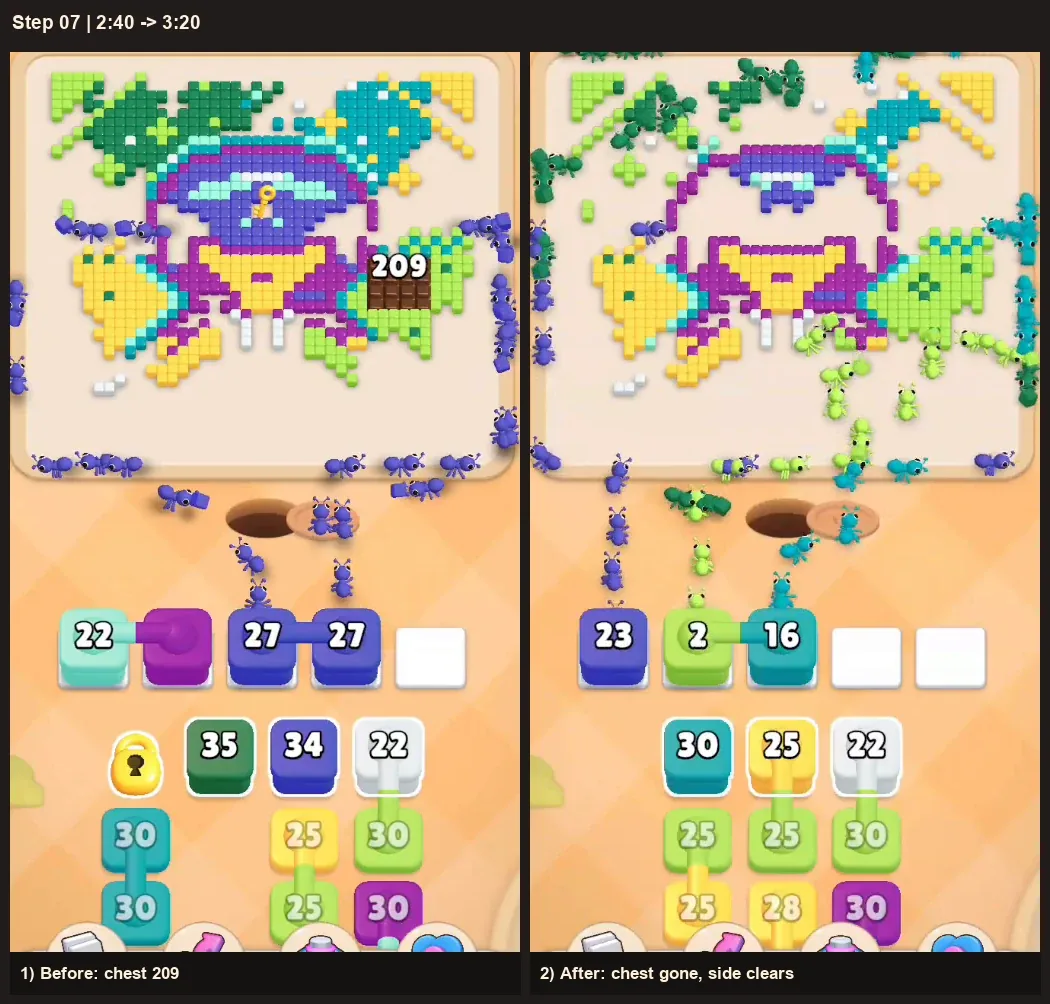
At 2:56 seats 3-4 take a Teal pair. Seat 1 turns Green at 3:06; at 3:14 seat 2 takes Light green while seat 3 stays Teal, and seat 1 turns Blue at 3:17. The chest counts 209 -> 83 at 3:00 -> 36 at 3:10 -> 9 at 3:15 -> 3 at 3:16, glows open at 3:17 and is gone at 3:18. The 3:20 row is Blue / Light green / Teal / empty / empty, with fill at 0.5051.
- What to do: keep the two Teal seats busy through the badge countdown - the chest tracks progress, not taps.
- Why it works: the lower side fields are pure teal-green, so the pair clears them while the badge runs out.
- Do not: invent a "chest colour" in the order; the glow at 3:17 is an opening transition, not a seat block.
Step 8 - Side fields thin (3:20-4:00)
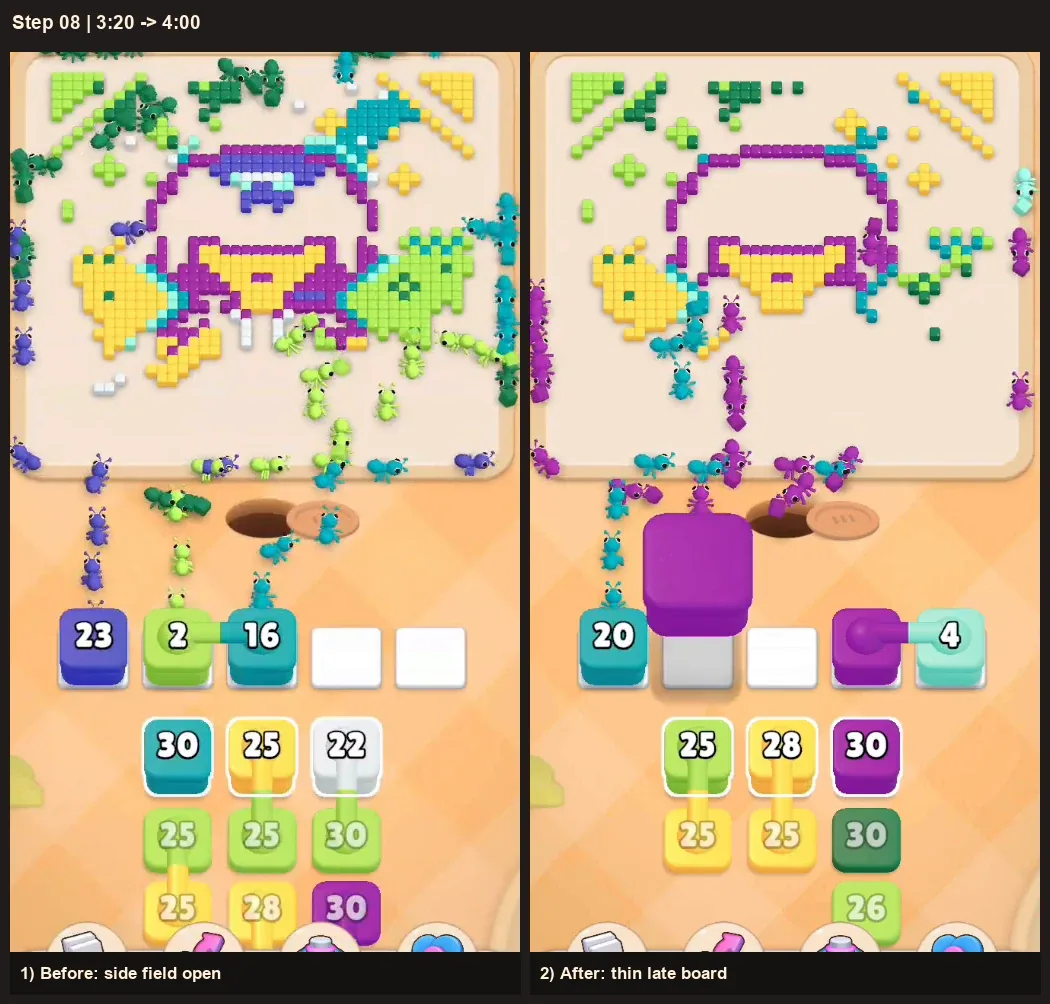
At 3:23 seats 4-5 take Light green / Yellow; seat 3 becomes Light green at 3:32 and seat 2 takes White at 3:35. At 3:41 seats 4-5 become Purple / Pale cyan, then seat 2 takes Purple at 3:51 and seat 1 takes Teal at 3:57. The stable 4:02 snapshot is Teal / Purple / empty / Purple / Pale cyan; fill is 0.4112 at 3:40.
- What to do: use 4:02 as the seat reference for this window, not 4:00.
- Why it works: the upper frame, right side and lower centre are separate islands by now, and each colour cuts its own.
- Do not: count the airborne Purple over seat 2 at 4:00 as a seated block.
Step 9 - Green, Light green and Yellow finale (4:00-4:20)
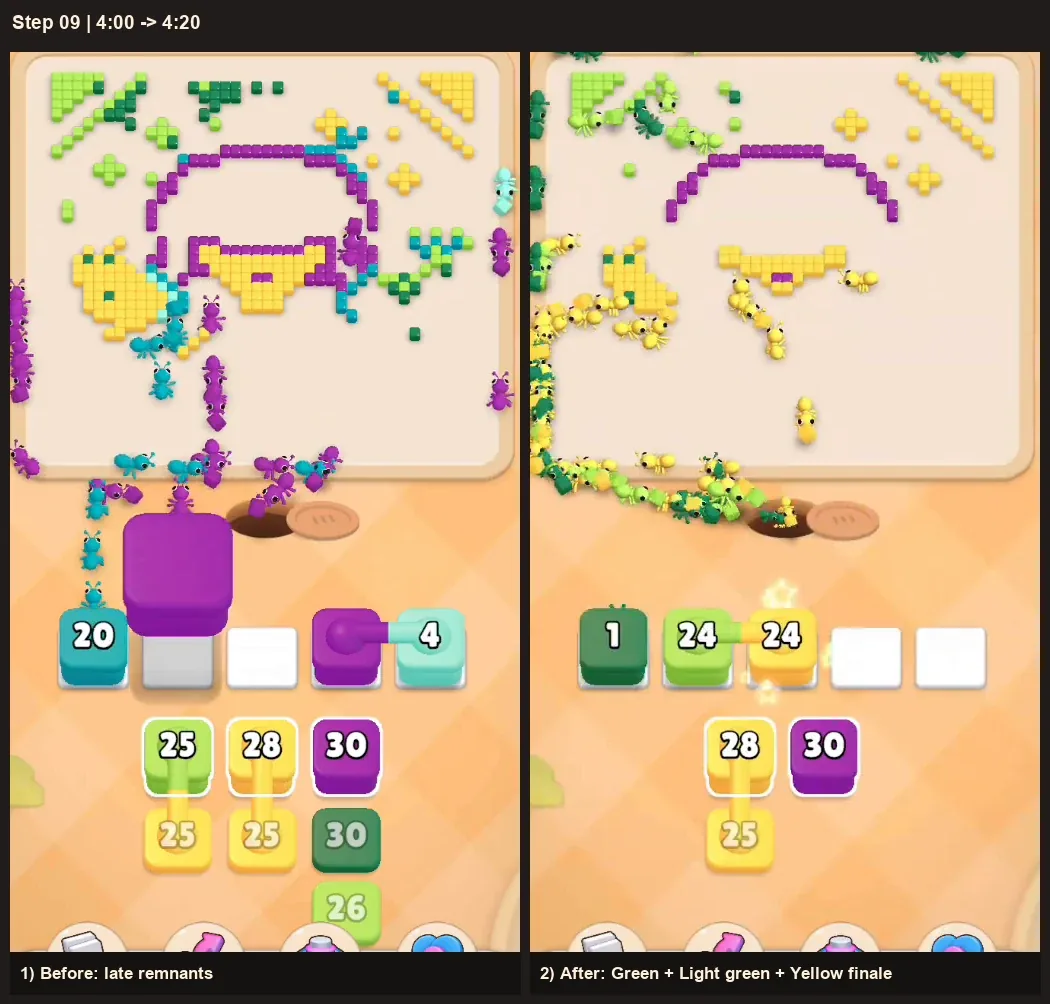
Seat 2 holds Purple through 4:02 and seat 3 takes Green at 4:06. At 4:09 seat 1 becomes Light green and seat 5 becomes Yellow, giving the stable 4:10 row Light green / Purple / Green / Yellow / Yellow. By 4:20 it narrows to Green / Light green / Yellow / empty / empty with fill at 0.2773.
- What to do: read the late seats as Yellow, not Orange - the bright warm edges over-read in the tracker.
- Why it works: the final islands are green foliage and the yellow chest patch, and the warm pair finishes the upper right.
- Do not: add an Orange seat that is not visibly printed on a block face.
Step 10 - Last Yellow chain and the empty board (4:26-4:29)
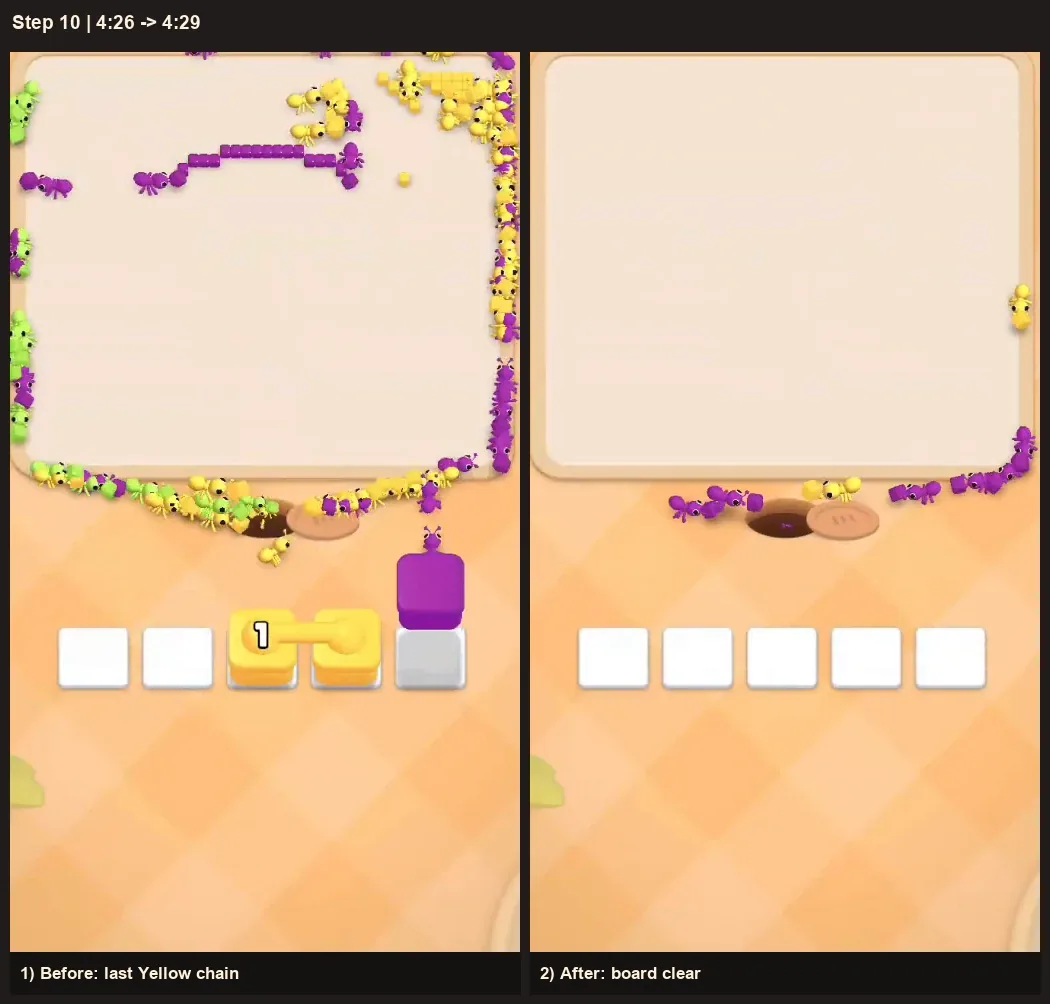
Seat 1 turns Light green and seat 4 takes Yellow at 4:22; seat 5 takes Purple at 4:23. The last stable pair is Yellow / Yellow on seats 3-4 at 4:25. At 4:26 all five seat faces are empty while a Yellow and a Purple block are still airborne, and they stay empty at 4:27. Fill drops from 0.2709 to 0.1789, then reaches the 0.1064 full-crop baseline at 4:29.
- What to do: quote 4:29 as the clear time and stop the tap list at the empty seat row.
- Why it works: the empty board is the last gameplay state; the logo at 4:30 and the Victory screen at 4:33 are overlays.
- Do not: count the airborne Purple above seat 5 as a seated block or extend the list into the overlays.
What each colour is doing
| Colour | Role on this board |
|---|---|
| Green / Light green | Large foliage-like upper and side fields; both the opening and the finale depend on this family |
| Teal / Pale cyan | Wing fields and pale highlights; the most frequently swapped pair, so require a stable block before naming it |
| Blue | Deep wing and lower-face fields; the mid-level Blue pair on seats 3-4 does the heavy work |
| Purple | The creature's face and outline; a backbone colour that also shows up airborne |
| Yellow | Chest patch, highlights and the final chain; the last stable pair is Yellow / Yellow at 4:25 |
| White | Pale trim and small highlights; a counted White block is occupied, not an empty seat |
| Orange | Small face accents only; bright Yellow edges over-read as Orange around 4:10 |
Three rules that carry the level
1. Keep the seats fed through multi-colour waves. The clear advances through clusters of three or four seats; do not let a single long drain leave the other seats idle. 2. Require a stable block before naming its colour. Teal/Pale cyan and Green/Light green are easy to confuse, and the 4:00 and 4:26 frames contain airborne blocks - confirm on adjacent frames. 3. Read the chest as progress, not as a colour. It counts through 3:16 = 3, glows at 3:17 and is gone at 3:18; the clear is the empty board at 4:29.
Common mistakes on level 1420
- Waiting for a five-seat opening wave when the first window only offers four colours.
- Reading the counted White block on seat 4 as an empty seat face at 0:33.
- Logging the one-frame Purple at 0:43 as a stable seat.
- Counting the airborne Purple over seat 2 at 4:00 or over seat 5 at 4:26 as seated blocks.
- Inventing an Orange seat from the bright warm edges around 4:10.
- Extending the tap list into the 4:30 logo or the 4:33 Victory screen.
Quick reference
Green·Green·Yellow·Light green -> Teal·Pale cyan·White·Blue -> Blue·Teal -> Purple·Teal·Light green·Pale cyan -> Blue·Pale cyan·Purple·Green -> Pale cyan·Purple·Blue·Blue -> Teal pair, then Blue·Light green·Teal -> Blue·White·Light green -> Green·Light green·Yellow -> Yellow pair -> clear at 4:29.
Colours in this level: Green, Light green, Teal, Pale cyan, Blue, Purple, Yellow, White.
The last stable seat blocks are the Yellow pair at 4:25; all five seats are empty at 4:26-4:27 and the artwork is clear at 4:29.